

Divided we fall
Sir,
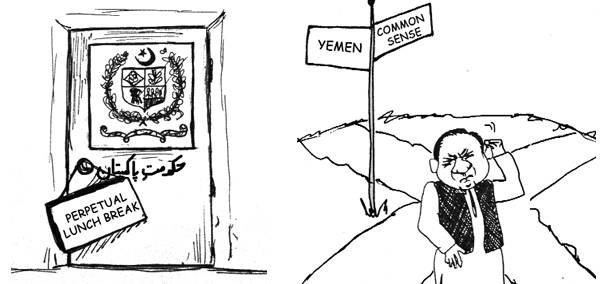
Two Lahore Churches became targets of ruthless suicide bombers on Sunday, March 15. Fifteen innocent worshippers, out of a pretty large number, engrossed in Sunday prayers at the time of the brutal attack lost their valuable lives in the dastardly attack and 75 suffered minor to major injuries. As reported in the print media, the death toll could have been larger had it not been for the security guards and volunteers on duty at the time of the attack, who blocked access of the suicide bombers to the churches. It was also reported that the audacious Taliban faction Jamaatul Ahrar claimed responsibility for the twin attacks at St John’s Catholic Church and Christ Church School, situated at a distance of around 400 meters from each other. Children and women were among the victims. Two policemen also lost their lives in the attack.
The tragedy naturally sent a wave of anger amongst the Christian community not only in Lahore, but across the length and breadth of the country. The Christian community, particularly in the city of Lahore, in fact, went too far in venting their anger. Apart from destroying public property and damaging public and private vehicles, they, out of sheer rage, burned alive two suspected men who may or may not have been involved in the attack.
The fact of the matter is that the terrorist attack on the churches was an attack on Pakistan. It should not be taken as an attack on a particular religious sect or community. The terrorists, the whole world knows, have killed more Muslims than people belonging to any other religion or sect in the country. Mosques, Imambargahs and places of learning have fallen victim to the barbaric acts of the ruthless terrorists in greater numbers. It must, therefore, be clearly understood by every segment of the society that terrorism knows no bounds and the terrorists attack on any segment of the society is, in fact, an attack on Pakistan. We will have to stand united, as Pakistanis, to win the war against terrorism and wipe out this menace from our society once and for all.
M Fazal Elahi,
Islamabad.
State and religion
Sir,
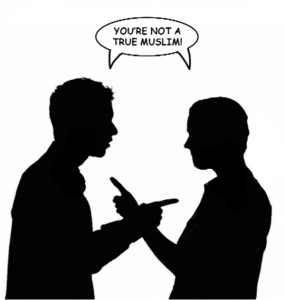
In the Sunni school of thought, all men are born equal and unlike physical features, nobility cannot be inherited. According to Maulana Asad, a religious scholar, there is no concept of either monarchy or dictatorship in Islam and amongst all prevalent systems of governance, democracy has a lot in common with the Islamic system.
The irony today is that it is in Sunni Muslim majority countries that monarchy exists with all its brutalities. Unlike Christianity, there is no concept of priesthood or professional clergy in Islam. Christian Europe suffered hundreds of years of brutalities because of the connivance of the Church and the State and finally came to conclusion that religion and state should be separated. Similarly it is time that Muslim world realize that insatiable greed of men in power willing to exploit religion for nefarious objectives has done more harm than good. This is precisely the reason why religion should not be allowed to be exploited by the State.
In Pakistan we have witnessed the manner in which a military dictator Ziaul Haq exploited religion and ethnicity, and decades after his death, citizens of Pakistan are enduring the consequences of his misadventures.
Tariq Ali,
Lahore.
Clear the air
Sir,
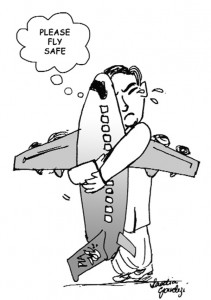
The tragic crash of a Germanwings A320 that killed over 150 people on board highlights the need by airlines to adopt measures to keep periodic and random check on the mental health of airline pilots, apart from their physical fitness and proficiency checks. There should be no tolerance for any airline pilot to continue to have a valid license if there are reasonable grounds to establish mental incapacity, or any doubts about such an illness developing at a later stage. Any pilot with any tendency for abnormal mental behavior should not be allowed by a regulator to hold a valid license. Such abnormalities can only be detected if regular psychiatric evaluations are conducted both by airline operators and regulators.
Incidents of PIA pilots coming drunk for flight duty have been reported not only within Pakistan, but at major international airports. The most recent of them involved a pilot who has a history of such irresponsible behavior, but was protected by his peers and colleagues. This irresponsible behavior reflects suicidal tendency.
Airline pilots with criminal record, including crimes for which they have served their sentences, should never be allowed by regulators such as CAA to have a valid license. In one such case, a PIA pilot charged with rape while on initial training in a foreign country was allowed to get out of the country to escape a trial. The incident was reported to the airline management, but no criminal report was filed by the complainant, nor was any psychiatric evaluation carried out.
Some years ago, a pilot was forced to resign after he raped a stewardess, but there were no criminal proceedings. His pilot’s license was not revoked by the CAA.
Rashid Orakzai,
Islamabad.
Crossroads
Sir,
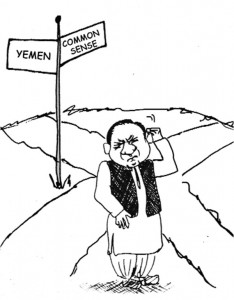
Following the physics of motion, the turbulence that pertains the state of Yemen at the present hour, is surely going to affect the global society at some point of time, consequently turning a regional conflict into a global one. While the Yemeni government along with the military backing of Saudi Arabia combats the Houthi rebels allegedly facilitated by Iran, a to-be-or-not-to-be situation characterizes Pakistan, a friend of Saudi Arabia.
Pakistan is standing at a harrowing crossroads where it is divided between the choosing of two options: either to blatantly announce the support of Saudi Arabia for which military assistance becomes a requisite. Or the indirect option that involves the psychological backing of Saudi Arabia. Either ways, Pakistan is doomed. Regardless of whether it plans to support Riyadh psychologically or militarily, its repercussions back home are certainly going to be grave. The general perception is that the Iran-Saudi Arabia rivalry springs from the Sunni–Shia divergence that has once again compelled the two powers to come against each other. Even if that is not true, if Pakistan interferes in the conflict, it will surely fan a Sunni–Shia divergence at home, especially after the gory acts of terror that have now become a pervasive sight on almost every religious event or religious day. Pakistan’s participation in the conflict would further create a divide between the two sects, escalating the tensions to unparalleled heights.
The million dollar question is, can Pakistan really afford to participate in the conflict? Are we not well aware of the fact that we are already engaged in a war. A war that is quite different from the conventional conflicts and a war that has a direct linkage to our very existence.
Acceptance of one’s failures and shortcomings is heralded as the very first step in the right direction. This is what Pakistan needs to do at the moment. We need to shed off the shackles of obliviousness that we have embroiled ourselves in. We need to accept the fact that we are a nation gripped by internal instability, a nation still coping with the grave repercussions of terrorism, and most importantly a nation suffering from an identity crisis. Acceptance of these truths will enable us to take rational decisions contrary to the hasty measures that have done more harm than good to us.
Staying away from direct involvement in the conflict does not entail that we become apathetic and breach the trust of our Saudi friends, nor does it mean that we strain our relations with our neighbor Iran. Instead, the need of the hour is to change our participatory role into a that of a mediator. Pakistan, along with its friend China, needs to mediate between Iran, likely supporting the Houthi rebels, and Saudi Arabia, supporting the Yemeni government to suppress the rebellion. Pakistan needs to make them see that a global propaganda is at work that endeavors to disintegrate the Muslim nations and compel them to wage wars against each other. This is something we should not allow.
The ball is in Pakistan’s court. We have to see whether we can emerge as saviors who protect the Muslim world from further disintegration, or will we – by direct involvement in the conflict – become a pawn in the hands of the global powers.
Marria Qibtia Sikandar Nagra,
Lahore.
Tongue twister
Sir,
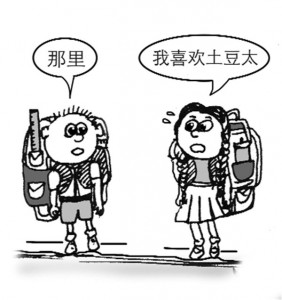
First they asked us to read Urdu, and we did it obediently because Urdu had become the national language. Then they came and asked us to read English, and we did that obediently again because English is the international language. And now they are asking to read Chinese. We will do it obediently as well because China is the emerging super power. We know that they will never ask to read our mother tongue Sindhi. Our primary school teachers have no command over their own mother language, how can they teach Chinese?
Of the 49,000 primary schools in the Sindh province, 42,000 are closed, due to one reason or another. Teachers are mostly absent from duty. Is this not a strange decision to teach Chinese language? Our regional languages, like Sindhi, will never have the same status as other languages. In this situation, how can we become more innovative? Innovations come only in mother language. It will not come from China through the Chinese language.
Aijaz Ali Khuwaja,
Karachi.
Art of governance
Sir,
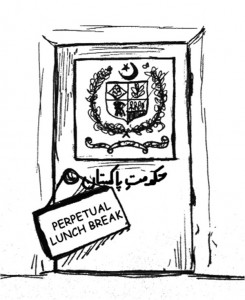
Pakistan’s most talented people should be motivated to join the civil services. The minimum educational qualification for the candidates should be a post-graduate degree, and the selection standards should be high. But then the salaries of the selected candidates should be in accordance with their abilities. The present pay scales of civil servants are much lower than those of the officers of state-owned organizations. State-owned enterprises do not recruit their employees through competitive exams held by the Public Service Commission on the bases of merit and regional quota.
It is also time to resolve the conflict within the civil services between a group of generalists and a groups of specialists. The dominant managerial generalists tend to command as generals, with an adverse impact on specialists. It is in the interest of good administration to recognize that the specialists can play a crucial role in making and administrating police, because of the extraordinarily complex challenges of governance in Pakistan.
In this context, it should be realized that the police and tax officers have very difficult tasks of exercising coercive powers of the government. Excellent performance by professional civil servants is required for success in these hard fields.
Taraq Jazy,
Lahore.
Open Letter to PM
Mr Prime Minister,
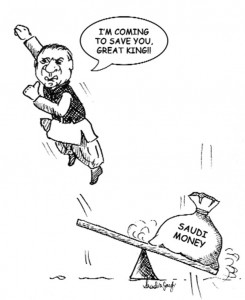
It is none of your business to defend the territorial integrity of Saudi Arabia.
You were elected not to protect the ‘Wahabis’ of Arabia, but the citizens of Pakistan that also include Shias, Christians, Ahmadis, Sikhs, Bohris and Hindus. You have utterly failed to do so.
You have failed to defend the territorial integrity of Pakistan – a part of which is now under TTP control. You have failed to curb a thousand autonomous private militias in Pakistan. You do not even control the roads of Clifton around the Bilawal House.
Countries that have 25 million children not going to school, do not even think of defending the territorial integrity of others.
Do not sell your soul and your country just because of some petty personal favours that you received from the world’s largest terror exporters.
Your personal compulsion to pay back the Saudi rulers could only result in the Yemenisation and disintegration of Pakistan. Your attempt to dilute the domestic war on terror is seen as a conspiracy to bog down the army in battle fields that do not belong to us.
Naeem Sadiq,
Karachi.