


With the Government of Pakistan imposing a ban on Bollywood movies to reciprocate the ban on Pakistani artistes on the other side of the currently tense Line of Control, we might not be able to discuss Indian offerings in this space for a few weeks.
Rest assured, it won’t be too long before Bollywood returns to Pakistan, without which, unfortunately, as things stand, local cinemas can’t even break even. And with no recent Lollywood release currently before us, we might be talking about Hollywood offerings in the near future.
This week there’s the much-hyped sci-fi fantasy flick Alita: Battle Angel. Set in the year 2563, Alita is based on Yukito Kishiro’s 1990s manga series Battle Angel Alita.
Earth has endured devastation in the form of war that has left all but one floating cities of the world completely destroyed. The only world that survives, Zalem, is fueled by the factories of Iron City.
One major problem: owing to the prodigiously detailed history of the manga version, it becomes near impossible to squeeze all the details in a single movie. That often results in either a story crying out for a backstory or one with relentless flashbacks from the past – an attempt to fit in as much history as possible. The latter is true for this live-action movie adaptation.
There is a blitz of flashbacks designed to give you an idea of who Alita might be and why the world is the way it is in the current setting. For most part the onus will be on you to put the pieces together for your own self. But if you’ve had even a fleeting interest in the subject, the storyline is sound enough for you to be able to put the jigsaw together.
The movie follows the early manga where Dr. Ido discovers a cyborg body in the scrapyard of Iron City. Not knowing that the cyborg body is a lot more than a piece of junk, he brings it to his clinic and gives it the body of his deceased daughter. He also gives her the same name, Alita.
Thus begins the protagonist’s journey to discover who she is and all the adventures that come with it. Alita finds love in a human being, Hugo, while constantly finding more about herself. She grows from being powerless to someone who takes on evil when her loved ones are threatened.
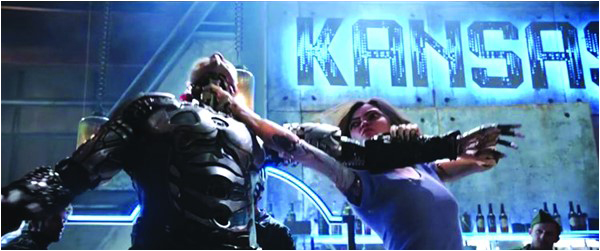
Alita has intense fight scenes which manage to engage the audience, especially in 3D where the special effects take the overall experience to a whole new realm. However, the overall effectiveness of the screenplay pales in comparison with those special effects.
There is just too much information to stuff into one movie and hence might just push away that section of the audience that does not self-identify as aficionados.
It is evident that James Cameron has read the entire manga and understood it well.And yet the movie eventually ran out of time to include everything – which, of course, is a lot.
From a visual perspective, there has been criticism on the abnormally large eyes that were given to the protagonist, which looked out of place especially because there were others in the film who were designed otherwise.

James Cameron has given the world super successful ambitious projects. This one limits itself to the ambition side of things, despite Cameron’s trademark cinematic vision palpable in the film.
Alita can be a decent watch if you like to travel to the future and be blown away by the special effects. But if you simultaneously want to make sense of a densely woven together storyline, you might want to give it a pass – or, of course, multiple watches!
Rest assured, it won’t be too long before Bollywood returns to Pakistan, without which, unfortunately, as things stand, local cinemas can’t even break even. And with no recent Lollywood release currently before us, we might be talking about Hollywood offerings in the near future.
This week there’s the much-hyped sci-fi fantasy flick Alita: Battle Angel. Set in the year 2563, Alita is based on Yukito Kishiro’s 1990s manga series Battle Angel Alita.
Earth has endured devastation in the form of war that has left all but one floating cities of the world completely destroyed. The only world that survives, Zalem, is fueled by the factories of Iron City.
One major problem: owing to the prodigiously detailed history of the manga version, it becomes near impossible to squeeze all the details in a single movie. That often results in either a story crying out for a backstory or one with relentless flashbacks from the past – an attempt to fit in as much history as possible. The latter is true for this live-action movie adaptation.
The overall effectiveness of the screenplay pales in comparison with the special effects
There is a blitz of flashbacks designed to give you an idea of who Alita might be and why the world is the way it is in the current setting. For most part the onus will be on you to put the pieces together for your own self. But if you’ve had even a fleeting interest in the subject, the storyline is sound enough for you to be able to put the jigsaw together.
The movie follows the early manga where Dr. Ido discovers a cyborg body in the scrapyard of Iron City. Not knowing that the cyborg body is a lot more than a piece of junk, he brings it to his clinic and gives it the body of his deceased daughter. He also gives her the same name, Alita.
Thus begins the protagonist’s journey to discover who she is and all the adventures that come with it. Alita finds love in a human being, Hugo, while constantly finding more about herself. She grows from being powerless to someone who takes on evil when her loved ones are threatened.
Alita has intense fight scenes which manage to engage the audience, especially in 3D where the special effects take the overall experience to a whole new realm. However, the overall effectiveness of the screenplay pales in comparison with those special effects.
There is just too much information to stuff into one movie and hence might just push away that section of the audience that does not self-identify as aficionados.
It is evident that James Cameron has read the entire manga and understood it well.And yet the movie eventually ran out of time to include everything – which, of course, is a lot.
From a visual perspective, there has been criticism on the abnormally large eyes that were given to the protagonist, which looked out of place especially because there were others in the film who were designed otherwise.
James Cameron has given the world super successful ambitious projects. This one limits itself to the ambition side of things, despite Cameron’s trademark cinematic vision palpable in the film.
Alita can be a decent watch if you like to travel to the future and be blown away by the special effects. But if you simultaneously want to make sense of a densely woven together storyline, you might want to give it a pass – or, of course, multiple watches!