

Sorrows of South
Sir,
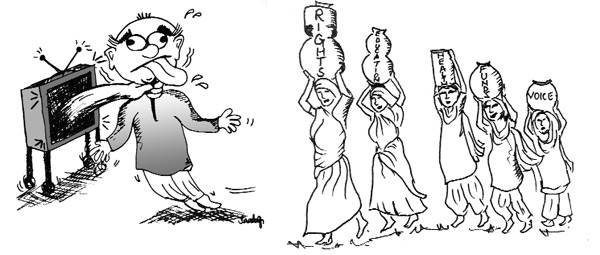
I hope the recent winds of change will also help millions of oppressed people who have been exploited in Baluchistan, South Punjab, rural Sindh, parts of Central Punjab, Khyber Pakhtunkhwa, and tribal areas for centuries. Pakistan’s national security and economic progress can only be ensured if equal rights, equal opportunities and security of life are enjoyed by all citizens, irrespective of their caste, creed, sex and ethnicity as provided in the constitution.
In spite of fact that numerous politicians from South Punjab have held important public offices, this region continues to be deprived of education, health and other basic necessities of life. It is an area where politics are dominated by feudals, landlords, gaddi-nasheens and industrialists, and those involved in crime, who deliberately never allow education to spread. While these politicians send their own daughters and sons abroad for education, they have ensured that if the government did venture to construct schools, the building is used for any purpose other than education.
Panchayats headed by the feudal elite deprive justice to the oppressed poor masses. It is the area with the highest number of ghost schools, notorious for crimes against women and forced labor. The powerful ruling elite of South Punjab fear that if the masses get education, their political domination stands to be challenged. This void has been filled by madrassahs, some of them serving as recruiting grounds for fundamentalist involved in terrorism.
It is time the federal government ensures that exploitation of the poor and crimes against women be curtailed through spread of education.
Tariq Ali,
Dubai.
Electric shock
Sir,
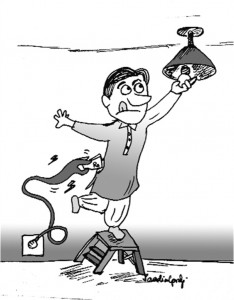
The Prime Minister’s Inspection Team has observed that WAPDA distribution companies (DISCOs) have installed new meters which run 30 to 35% faster than the old ones. There has been great hue and cry all over the country regarding excessive billing and the people have been thronging WAPDA offices for correction of their bills. But in return they could only get installments made out of their inflated bills not knowing that they would be paying extra surcharge of unpaid dues in the next few months.
I for one have been going to the LESCO office regularly every month for the last two years for correction in my inflated bills. With my continuous protests I could only manage installation of a “Check Meter” which was an identical meter but they assured me that it was a tested meter. Since there was no difference in the consumed units on both the meters, I was told to pay the actual bill. The concerned XEN told me that there must be leakage of electricity in my house as I told them that I did not consume so many units. But they insisted that the reading was correct as per the check meter. I got my wiring checked througha private electrician but nothing was wrong and there was no leakage.
As per the findings of the Inspection Team, all consumers who have new meters have been paying extra for the last two to three years and they must be compensated.
The government is requested to order WAPDA’s DISCOs to reimburse the consumer the extra money they have paid. It may be mentioned here that it is not a new thing with WAPDA. They have been doing it since long to cover leakages and thefts. Once a technician of a company that supplied meters to WAPDA told me that meters are deliberately made to run fast as per the instructions of WAPDA authorities.
A commission should be appointed to find out since when law abiding consumers are being fleeced in this way, and the inquiry should include the manufacturers of meters.
Muhammad Azhar Khwaja,
Lahore.
National security
Sir,
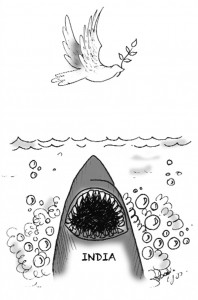
Border tensions with India warrant that Pakistani state institutions work in coordination with the elected government to forge unity within our ranks. It is vital for national security interests of this country and for success of Pakistan’s role in the war against terrorism that the international community ensures tensions on our eastern border are diffused. Similarly, we need to eliminate sectarian terrorist gangs allegedly involved in criminal acts across our border with Iran.
As a nation, we must understand that it is in our national interest that criminal armed private militias patronized and funded by sectarian and other extremist organization working under garb of religion be eliminated, and under no circumstances should they be allowed to resurface. It also does not serve our national interest that political parties indulge in saber rattling over the issue to gain cheap popularity.
Pakistan continues to be misrepresented internationally. This country must understand that public office holders, political leaders, including members of the security establishment, must not have a conflict of interest, or loyalty to any other entity than Pakistan.
Some political parties are so obsessed with their protests that they conveniently forgot that it was customary to hold demonstrations outside the UN with Annual General Assembly in session, demanding plebiscite in Kashmir, condemning human right violations, incidents of rape and mass killing by the occupying Indian army against unarmed Kashmiris demanding basic right of self determination.
Ali Malik,
Lahore.
Challenges and China
Sir,
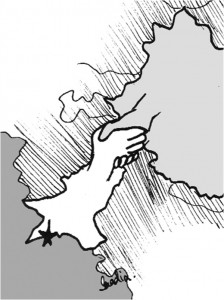
Pakistan has always had exemplary relations with its neighbor China. This kind of outstanding closeness has been possible only due to a long term and consistent goodwill that both countries have extended towards each other. Pakistan’s disappointment from its Western security, the end of Sino-Soviet rapprochement and the Sino-Indian border war of 1962 which brought massive military aid of America to India, were the factors that pushed China and Pakistan closer to each other in the 1960’s.
Despite being a US ally of three Western security arrangements, Pakistan never got such magnitude of aid that was given to India which was around $1,705 million. Furthermore, this was threatening Pakistan’s position and a fear was being felt that India would use this aid against it which led to review its foreign policy options.
Pakistan turned to China with whom relations had already been improving and received a positive response. Through this strategic vision, Chinese friendship became an essential and never changing pillar of Pakistan’s foreign policy. This was the beginning of a new era in bilateral relations, which continued uninterrupted in the subsequent decades.
In critical times, Pakistan has always proved to be a best friend such as in the two Indo-Pak wars of 1965 and 1971 by playing a role of an elder brother. Military aid was extended and war losses were compensated to a considerable degree. This gesture pointed that existence of a dynamic Pakistan was vital for China’s security interests and territorial integrity in the South Asian strategic scenario.
At a time when no other country was ready to intervene to stop the war, China once again came to our rescue. It directly jumped in to support Pakistan issuing an ultimatum to India for a ceasefire. China warned Indian Embassy in Beijing on 16 December 1965 to stop all military related exercises in adjacent area of Chinese occupied Sikkim border and warned to open the second front in this area and warned that in case of failure, India would be responsible itself for grave consequences.
Responding to this friendly gesture, Pakistan played a significant role in restoring Chinese status in the UN and became instrumental for Sino-US rapprochement. Pakistan facilitated a trip of US envoy Hennery Kissinger, American National Security adviser, to China. The sensational news of Hennery Kissinger’s visit to China via Pakistan in July 1971 became a surprise for the world and helped in breaking China’s isolation. Pakistan had worked as a bridge between China and the US for diplomatic recognition and restoring its membership in the UN. This interaction transformed the Chinese position of a regional actor to a global one.
China used its first ever veto to hold Bangladesh’s application for membership in the UN displaying its favour towards the territorial integrity of Pakistan. After this, the friendship between the two countries moved to a comprehensive strategic partnership for peace and development in the world and particularly in the region. Since then, China has always carried the responsibility of following an ‘all-weather friendship’ and has never betrayed us at any point.
China became the major source of nuclear power and modern weaponry for Pakistan and also very significant for bringing forth trade and investment into the country. Since 1993, China’s nuclear co-operation has been working at Chashma and a 300-megawatt nuclear power plant was completed in 1999. It is the first example outside the western world of exporting a power reactor to a developing. China assisted Pakistan in building two defence-related mega projects, first was the Heavy Industries Taxila and its part Heavy Rebuild Factory and second was the F-6 Aircraft Rebuild Factory.
China has also supported us in developing infrastructure and funded for building Gwadar and linking it to other areas. China is displaying its might in vicinity of the subcontinent with its strategic presence at the Gwadar Port project.
Sino-Pak all-weather friendship is based on unparallel trust, mutual understanding and convergence of views on political, diplomatic, economic and strategic levels. These sentiments are being shared by both sides irrespective of any specific leadership or era. This relationship has become a long-term strategic partnership aiming to promote, peace, stability and prosperity in the region. In changing global scenario, both countries are making attempts to address the challenges that are destabilizing the region and threatening its security.
Amna Malik,
Islamabad.
Win win
Sir,
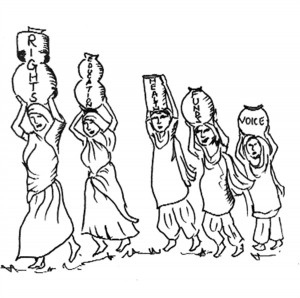
The Region South Asia is conflict prone and volatile in nature. The two main nuclear states India and Pakistan have a history of conflicts with each other. After US withdrawal from Afghanistan India wants to keep her position strong in Afghanistan and put Pakistan under pressure by placing her forces near Pakistani border. India, where the right-wing Narendra Modi has been elected the prime minister, is very disappointed to see Abdul Ghani as the President of Afghanistan. Certain possible solutions can be adapted by both states to dilute the tense situation.
Another round of confidence-building measures should be initiated to create an enabling environment for both the states to negotiate solutions to their conflicts. International powers should play an effective role as mediators.
Pakistan’s policies towards India are still not clear. We should deal with India diplomatically, but use proper tactics. When Nawaz Sharif went to India, he should have discussed vision 2025 with Modi rather than discussing other issues.
Both the states are nuclear powers and cannot afford a conflict because it will lead to mutually assured destruction. The need of hour is that Islamabad and New Delhi should resolve their differences on win-win grounds.
Nazia Parveen,
Rawalpindi.
Stop press
Sir,
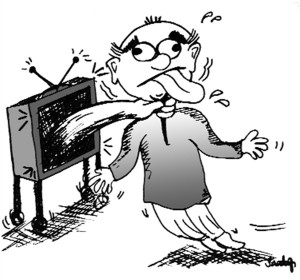
While I condemn restrictions on private television channels, it must be emphasized that an independent responsible media following universally adopted ethics and morals, involved in dissemination of news without any bias, blackmail or conflict of interest plays a vital role in protecting public interest and promotion of democratic culture. The problem with our electronic media is its fast growth, without a powerful independent regulatory authority in place and insufficient qualified professionals to serve as anchors or analysts.
Ratings, sensationalism, political biases and lack of editorial supervision, with petty commercial interest have seen vital public interest issues being ignored, or people’s rights violated. Power must come with responsibilities otherwise there will be abuse and distortion of facts, and instead of promoting a democratic culture, they end up promoting intolerance.
In the US, where the state does not own or run electronic media, Fox News serve spokesmen of the Republican Party and its ideology, and viewers are not told that it is an independent channel. In Pakistan, unregulated grant of licenses without any supervisory regulation or code of conduct has served the interests of specific power blocs, instead of public interest. Politically biased individuals serving vested interests are projected as independent analysts.
The recent unethical channel wars have not only harmed their credentials, but also resulted in use of violence to damage their opponents, which has harmed their credibility and waste of air time that should have been dedicated to serve public interest issues.
Zahid Shafiq,
Islamabad.