

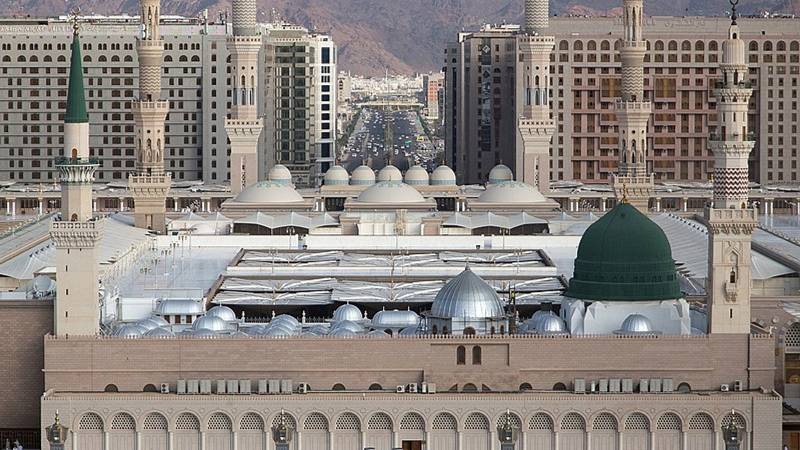
The month of Rabi-ul-Awwal holds a most special place for Muslims. This is the month in which our most beloved Prophet (PBUH) was born. I was once asked, nearly 30 years ago, by a French police officer while I was serving in the UNIPTF Mission in Bosnia-Herzegovina, why the name Muhammad (PBUH) reverberates so deeply with Muslims. It was a mystery to him that our Prophet (PBUH), who lived 1,400 years ago, still impacts his followers in ways not even their parents or any other person can. His observation was spot on.
Writing something about our Prophet (PBUH) is not easy. When emotions run so deep, scholarship takes a back seat. Whether one is a devout Muslim or a non-practising secular one, the name of Prophet Muhammad (PBUH) resonates in the soul like a magical potion. Feelings of love, admiration, pride, and respect seep through every cell automatically. I have seen Muslims, even in extreme anger, become quiet and respectful as soon as this most exalted name is mentioned.
In my opinion, our reverence towards him is because of two fundamental reasons.
The first is that Prophet Muhammad’s (PBUH) name is the first human name a Muslim child hears immediately after birth, as soon as the Adhan is called. Immediately after the name of Allah, his most glorious name pierces the ears of the newborn and settles deep inside the heart and soul. And thus, the journey of Ishq commences.
The second reason is that we are taught in the minutest of details how our Prophet lived his life. His biography is the most detailed in all of human history, starting from his birth and continuing through his impact on subsequent human events. What other person has had any comparable persona even remotely, across the aeons?
Celebrating Rabi-ul-Awwal is very important. But more important is to mould our lives according to the supreme example of our most beloved Prophet (PBUH)
For a moment, close your eyes and try to travel back to 6th-century Arabia. Before the Prophet (PBUH), the Arabian Peninsula was home to diverse groups, including nomadic Bedouin tribes practising polytheism and sedentary communities in the south, with significant Jewish and Christian populations elsewhere. Societies were tribal-focused with strong patriarchal structures and a code of honour often leading to inter-tribal warfare and raids. Social issues like slavery and a low status for women were prevalent, with widespread female infanticide.
The reply of Hazrat Ja‘far bin Abi Talib to the Ethiopian King Negus portrays that society as follows:
“O King! We were plunged in the depths of ignorance and barbarism; we adored idols, we lived in unchastity, we ate the dead bodies, and we spoke abominations. We disregarded every feeling of humanity, and the duties of hospitality and neighbourhood were neglected; we knew no law but that of the strong.”
In this abyss of darkness, our most beloved Prophet (PBUH) was born in 570 CE. In that tribal structure, his level of character was so profound that even his worst enemies gave him the sobriquet “Sadiq” and “Amin”. He transformed the foundations of Arab society, changing the course of history for all time. In a short life of only 63 years, he laid the foundation of Islam on the basis of the Holy Quran and his Sunnah. This led to the rise of Islam like a phoenix, with the result that less than 50 years after him, the nascent Islamic caliphate was already a vast and powerful force, laying the groundwork for what would become one of the largest empires in human history.
But it is heartbreaking to see what we have done with his great religion. Despite there being 57 Muslim countries, we are nowhere on the world map. As of 2024, the Nobel Prize has been awarded 627 times to a total of 1,012 individuals and organisations, with 976 unique recipients. Sadly, the 2 billion Muslims have only 15 Nobel Prizes. Look deeper, and it is worse: there are only four Muslim Nobel winners in the sciences. It becomes more depressing when we realise that the first Ayah of the Quran was: “Read! In the name of your Lord who created man from a clot of blood.” Subsequently, Muslims ruled the scientific world for centuries.
What better tribute can we give to our most beloved Prophet (PBUH) than vowing to start living our lives according to his commandments? For this, we will have to bury the materialism that has seeped into our fabric. For us, this world has become more important than the life hereafter. The simplicity, compassion, honour, dignity, integrity, bravery, foresight, and so many other attributes shown by our Prophet (PBUH) need to be inculcated afresh. Loving him means much more than just paying lip service. The Ishq we have for him commands us to reignite the fire. We need to study his life and seek guidance.
Our Prophet (PBUH) never compromised on his principles, despite the gravest threats to his life. He showed, through personal example, what compassion is when he was injured by the people of Ta‘if, yet he prayed for them. He exhibited the epitome of Sabr when, for three years, he and his companions had to live in Shi‘b Abi Talib and barely survived. He personally dug the ground in preparation for Ghazwa Khandaq, although he had the resources of the Universe at his disposal. I could write volumes about this greatest personality.
Celebrating Rabi-ul-Awwal is very important. But more important is to mould our lives according to the supreme example of our most beloved Prophet (PBUH). We all love him from the depths of our souls. Let us resolve to love him more through practice as well.