

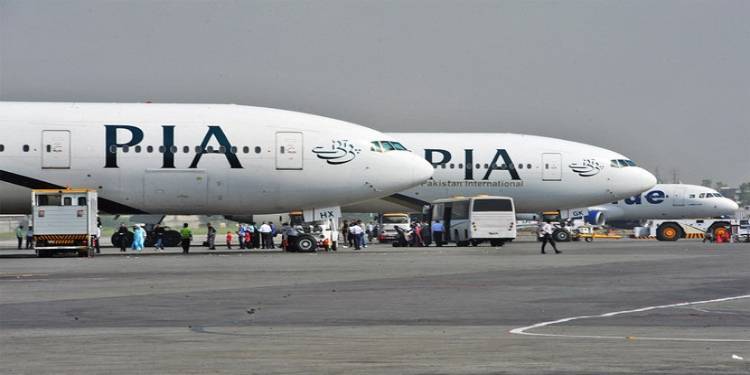
A dozen airports across Khyber Pakhtunkhwa (KPK) and Balochistan, which have gained strategic importance amid the recent wave of terrorism, currently remain without flight services. Operations to these destinations have been suspended for several months due to an artificially created shortage of ATR aircraft pilots.
Well-placed sources within the national airline told The Nation that the engineering branch has virtually collapsed and is failing to meet operational requirements, resulting in numerous issues for the carrier.
No heads have rolled over a recent disaster in which an Airbus aircraft took off from Karachi and landed in Lahore with one tyre missing—an incident unheard of in recent times. Despite this, and other maintenance failures, there has been no accountability. The former head of engineering retired honourably upon reaching superannuation last month without being held responsible for the disastrous incidents under his watch. He has since secured an elevated position in another organisation.
Sources revealed that over 50 engineers had written to the then-Director of Engineering, raising concerns over tense working conditions. Senior engineers had reportedly employed pressure tactics—such as arbitrary postings, transfers, and suspensions—to push through questionable directives. This toxic environment severely impacted aircraft maintenance. However, their letter remained ignored for nearly eight months.
More than 70 highly qualified engineers and 90 trained technicians—mostly foreign-trained—left the airline during the tenure of the Chief Engineer, opting instead to join airlines in the Far East and Middle East. Despite this mass exodus roughly six months ago, no serious effort was made to stem the outflow—a direct loss to the national flag carrier.
Due to this shortage of engineers and technicians, the airline's maintenance capabilities are unlikely to support any future fleet expansion. Last week, a Boeing 777 was grounded due to the unavailability of an engine, and despite advance knowledge, the engineering leadership failed to secure a replacement. Previously, the airline maintained two to three spare engines for each aircraft type to prepare for such emergencies.
Hajj pilgrims booked on this flight were left stranded despite holding confirmed tickets.
In another troubling incident, an Airbus A320 landed on the wrong runway at Lahore on 17 January. While the pilots were grounded, sources assert the problem is not limited to the cockpit. Ineffective administrative control by the Chief Pilot of Airbus operations has exacerbated the situation. Formerly Chief Pilot of ATR operations, he is said to have deliberately dismantled services to remote and coastal areas in Balochistan and KPK by grounding ATR aircraft. After achieving this, he quickly transitioned to Airbus 320 operations, becoming an examiner pilot.
His reported mismanagement in pilot training is believed to have contributed to the Lahore runway incident and several other operational mishaps. A key motivation, sources suggest, lies in salary disparities: Airbus pilots earn nearly double compared to their ATR and Boeing 777 counterparts. This flawed distribution of pilots has created a mismatch—excess pilots on the Boeing 777 and Airbus 320, and a severe shortage on ATR aircraft.
Due to this artificial shortage, nearly half of Pakistan has been cut off from air connectivity. Flight operations remain suspended to vital airports such as Pasni, Zhob, Dera Ismail Khan, Bannu, Turbat (from Islamabad), Rahim Yar Khan, Mohenjodaro, Multan, Faisalabad, Lahore, and Peshawar. All these destinations were previously accessible by air.
Flight operations to Chitral were scheduled to commence on 5 April 2025, but were cancelled just days before the planned start due to the ongoing pilot shortage.
The situation worsens with reports that three ATR aircraft were deliberately decommissioned and stored in a Karachi hangar under the pretext of being “not commercially viable.” Despite being in perfect condition, these aircraft have remained idle for three years while the airline continues to pay millions of dollars in lease payments.