

Repair all gas leaks
Sir,
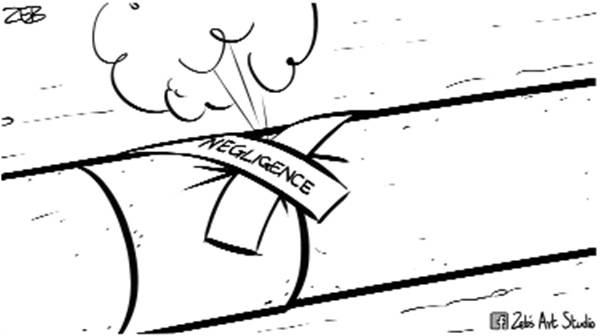
Nowadays very little gas is making its way to consumers, forcing the populace to discover and adopt other means of cooking their food or warming their homes. The reason given to us for this phenomenon is that because of the cold weather, not enough pressure is built up. But this is not true. In many places, gas is leaking from pipelines and nothing is being done about it.
For the last four years, I have observed that gas lines situated in a house close to St John’s Church, Mirpurkhas has broken down and as a means of repairing it, it is joined together with some red tape. The joint is so poorly done that gas is leaking continuously. One can hear it leaking as we walk along the road. I approached the house outside which the pipeline was situated, and cautioned them about it, but they denied that it was their connection and insisted it belonged to their neighbor. All this shows the negligence on the part of the authorities and consumers.
I request gas authorities Sui Northern and Sui Southern to check all gas connection leeks and fix them permanently. To all consumers, it is highly recommended that they check their individual connections and get the authorities to fix them immediately. If all do their part responsibly, then I guarantee that there will be a considerable improvement to the gas pressure all over the country.
Abid Habib,
Mirpurkhas.
Positive move
Sir,
Prime Minister Nawaz Sharif and Finance Minister Ishaq Dar are attending the World Economic Forum, which is currently being held these days in Davos, Switzerland. I believe this forum provides an important opportunity to meet and interact with the world’s top financial and economic leaders, and get some tips and experiences, which can be used for the country’s economic benefit. I also believe that the PM or the finance minister should interact with the international media during this important economic summit and express their views on the world economy and the potential of Pakistan’s economy. Such an interaction between our PM and FM with the international media, which is heavily present in Davos during this World Economic Forum, will improve our country’s image and economy.
Ejaz Ahmad Magoon,
Lahore.
Islam misrepresented
Sir,
Once again blood has been spilled, screaming has been heard and mourning will be held in the coming days. Once again, more than 25 innocent university goers in Bacha Khan University, Charsadda, have been brutality killed and many dozens severely injured by barbaric so-called saviors of Islam. Does any Islamic principle allow for the killing of innocent children in APS Peshawar and now in Charsadda? If this is their Islam, I’m better off being a human than Muslim.
Alas! Many youngsters have been brainwashed, misguided and misled by these so-called Islamic fighters. They get their recruits by promising them a ticket to the heavens. To win a final victory and to save humanity, it is the duty of religious scholars, along with the state, to depict the true image of a peaceful Islam.
Muhammad Waqas Haral,
Rawalpindi.
Who will shed
a tear?
Sir,
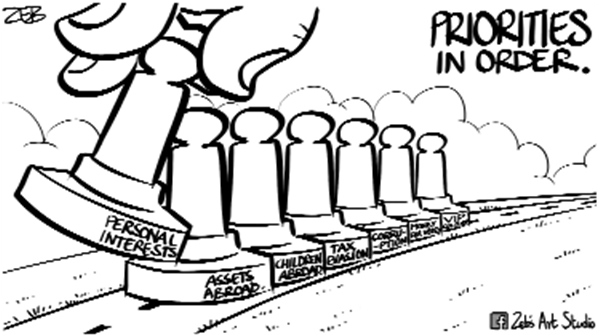
Over 21 innocent students and a professor were brutally murdered by terrorists in Charsadda . Who will shed a tear for them other than their parents, siblings and next of kin? Would the PM not have dashed back to Pakistan if God forbid, it was one of his children who had been a student at the university?
If President Obama, the most powerful elected leader in the world, can shed a tear in the memory of the victims of Sandy Hook Elementary School, while addressing the issue of gun control in America, what stops our ruling elite and establishment from doing the same. Mere condemnations, days of mourning and promises of crushing those responsible will not resolve this grave crisis, unless there is a will, translated into action with zero tolerance for any private militias or criminals, whatever their affiliations.
This disconnect between the people and the ruling elite is becoming wider. It is time we stopped blaming our known enemies for killings, which they fund, and start facing the ugly reality that some of our own citizens are being brainwashed within our country with a distorted version of Islam and are trained to unleash these horrors. Our enemies will continue to exploit loopholes that corruption and greed offer.
It was in the 80’s when the factories of mercenary jihadists were created in Pakistan and those responsible minted billions from this ugly brutality that would unleash terror on the citizens of Pakistan. Men like Ziaul Haq, Akhtar Abdur Rahman, Hameed Gul and politicians and bureaucrats who were their partners were villains, who did not deserve honorable burials. We failed to forfeit billions that were made by these merchants of death and deceit, most of it conveniently transferred to foreign safe havens and even today those who benefit from this criminal economy are allowed to get away. Unless this institutionalised money laundering is not eliminated and those thriving from the criminal economy not given exemplary punishments, crime and terrorism will continue to haunt us. It is we who must put our own house in order and stop allowing ourselves to be used for proxy wars. Our sole strategic assets should only be our armed forces, military hardware and state infrastructure, not any private militia.
Ali Malik,
Lahore.
PM’s absence
Sir,
We are being told that Pakistan is fighting a war for its survival against terrorists and yet as far as the elected PM is concerned, it seems to be business as usual. British PM David Cameron and US VP Joe Biden visited Davos for a day, but our PM has chosen to stay back as per schedule, although there has been a very brutal attack by terrorists in Charsada with fatalities of over 21 and over 40 injured. The significance of the Davos summit can be gauged from the fact that Indian PM Modi and many other leaders of Asia did not attend, because they thought it more important to tackle issues, which they face in their countries.
Why this cold response from the Pakistani PM? When Paris faced an attack from terrorists, President Hollande chose not to attend the G12 Summit in Turkey, because he considered it his moral obligation to stay back and express solidarity with the victims of terrorism. This callous and cold attitude has become routine for our elected public officeholders and military dictators who have ruled this country. When Sindh and the rest of Pakistan was ravaged by floods, President Zardari considered it appropriate to proceed abroad to visit his villa in France. What purpose do these frequent visits serve since our exports are on a constant decline, while imports have risen. As far as remittances are concerned, the government has not contributed to them. It is time that fiscal discipline is enforced from the top, because Pakistan cannot economically afford such luxuries.
G Zaman,
Peshawar.
Democracy strengthening
Sir,
After three military takeovers and frequent changes of political governments, democracy is now grabbing and deepening its roots in Pakistan. Since 2007, democratic governments are running affairs in Pakistan. The recent local government elections in Sindh and Punjab held in October showed confidence in voters and political parties. Voter turnout remained higher than all other previous elections. It was a trend of military governments in Pakistan to conduct local government elections, but now this time political governments in provinces have taken responsibility and conducted elections in an overall peaceful atmosphere, except some minor incidents. Elections in Sindh remained the bloodiest due to 11 people being killed in Khairpur, the district of sitting Chief Minister Syed Qaim Ali Shah. The Pakistan Peoples Party (PPP) won a thumping majority in Sindh and the Pakistan Muslim League-Nawaz in Punjab. Local government elections had already been held in Khyber Pakhtunkhwa and Balochistan. It was Balochistan that took the lead in conducting local government elections. Now, political boundary lines have been drawn between different parties in Pakistan. Punjab is the stronghold of the PML-N, PPP in Sindh, PTI in KP and nationalist parties in Balochistan. PTI was defeated by PML-N in Punjab. This was the first phase of LG elections in Sindh and Punjab. PTI’s defeat in the first phase of elections in Punjab showed that people want delivery, not speeches. PPP made some inroads in Punjab, which they all lost in 2013 general elections. Voters have showed some light to PPP for future elections. PPP almost remained unchallenged in Sindh. Now is the right time for the PPP to work hard in Sindh, where the provincial government is in their hands. PPP’s work in Sindh will impact Punjab and other provinces as well. However, independent candidates in Sindh and Punjab have turned tides and remained second largest winners in the provinces. In Pakistan, most independents join ruling parties when they are elected as independent candidates. Independent candidates are mostly disgruntled elements of political parties who leave parties due to differences on allotment of party tickets.
Aijaz Ali Khuwaja,
Karachi.
Fence for defence
Sir,
A laudable announcement was made by Defence Minister Khawaja Asif in the Senate on 21 January that he agreed to a proposal that there should be a fence to seal our western border. The critical issue of cross-border movement between Pakistan and Afghanistan was raised by Senator Muzaffar Hussain Shah. Such a measure to manage large scale disorder on this porous mountainous border is in the vital interest for peace and prosperity in the AFPAK region. Without such a fence, it would be a fancy dream that the western route of the CPEC would be a useful development project.
Taraq Jazy,
Lahore.
Anachronistic policy on Kashmir
Sir,
Here is a piece of history by Nyla Ali Khan, a Kashmiri scholar at the Oklahoma University, which raises pertinent questions about the willingness of both Pakistan and India to resolve the Kashmir dispute, amicably, bilaterally under UN resolutions. Policymakers need to evaluate the available options and understand the situation keeping in view the Kashmiri people’s aspirations, fears and reservations.
In the interests of expediency, the UNCIP appointed a single mediator, Sir Owen Dixon, the United Nations representative for India and Pakistan, Australian jurist and wartime ambassador to the United States, to efficiently resolve the Kashmir conflict. Dixon noted, in 1950, that the Kashmir issue was so tumultuous because Kashmir was not a holistic geographic, economic, or demographic entity, but, on the contrary, an aggregate of diverse territories brought under the rule of one maharaja. In a further attempt to resolve the conflict, Sir Owen Dixon propounded the trifurcation of the state along communal or regional lines, or facilitating the secession of parts of the Jhelum Valley to Pakistan.
Despite the bombastic statements of the governments of both India and Pakistan, however, the Indian government has all along perceived the inclusion of Pakistani-administered J&K and the Northern Areas into India as unfeasible. Likewise, the government of Pakistan has all along either implicitly or explicitly acknowledged the impracticality of including the predominantly Buddhist Ladakh and predominantly Hindu Jammu as part of Pakistan. The coveted area that continues to generate irreconcilable differences between the two governments is the valley of Kashmir.
Dixon lamented: “None of these suggestions commended themselves to the PM of India. In the end, I became convinced that India’s agreement would never be obtained to demilitarisation in any such form, or to provisions governing the period of the plebiscite of any such character, as would in my opinion permit the plebiscite being conducted in conditions sufficiently guarding against intimidation and other forms of influence and abuse by which the freedom and fairness of the plebiscite might be imperilled.” (The Statesman, 15 September 1950).
Sir Owen Dixon nonetheless remained determined to formulate a viable solution to the Kashmir issue and suggested that a plebiscite be held only in the Kashmir Valley subsequent to its demilitarisation, which would be conducted by an administrative body of UN officials. This proposal was rejected by Pakistan, which, however, reluctantly agreed to Sir Dixon’s further suggestion that the prime ministers of the two countries meet with him to discuss the viability of various solutions to the Kashmir dispute. But India decried this suggestion. A defeated man, Sir Dixon finally left the Indian subcontinent on 23 August 1950.
There seemed to be an inexplicable reluctance on both sides, India and Pakistan, to solve the Kashmir dispute diplomatically and amicably. Sir Dixon’s concluding recommendation was a bilateral resolution of the dispute with India and Pakistan as responsible parties, without taking into account the ability of the representatives of the people of J&K to be the architects of their political future. Is this the anachronistic policy being toed by the governments of India and Pakistan in 2015?
What Pakistan needs to do is to exploit effectively and forcefully the rebutting of the Indian claim of occupied Kashmir being part of India, by the Jammu and Kashmir High Court that has recently ruled that the State has never been part of India. “Article 370 of Indian constitution that deals with the status of Jammu and Kashmir is beyond abrogation, repeal or even amendment,” the high court said in its ruling the other day. “Article 35A gives ‘protection’ to existing laws in force in the State. Article 370 though titled as ‘Temporary Provision’ and included in Para XXI titled ‘Temporary, Transitional and Special Provisions’ has assumed place of permanence in the Constitution,” a division bench of justice Hasnain Masoodi and Janak Raj Kotwal ruled in a 60-page judgement. “It is beyond amendment, repeal or abrogation, in as much as Constituent Assembly of the State before its dissolution did not recommend its Amendment or repeal,” the bench ruled.
The decision has been highly welcomed by the local parties and political figures representing the major population, Muslims. Peoples Democratic Front (PDF) President and Awami Muthida Mahaz (AMM) leader Hakim Mohammad Yasin welcomed the landmark judgment. They said, “Now the challenge for Jammu and Kashmir government is to further strengthen Article 370. According to the ruling, the Article 370 is a permanent provision of the Constitution and it cannot be abrogated, repealed or even amended. “It is a welcome decision.
One remembers the words of Chief of Army Staff General Raheel Sharif, who, on the eve of Golden Jubilee of 6 September war of 1965, said in his speech: “Kashmir is the unfinished agenda of the subcontinent’s partition. The people of Indian occupied Kashmir are being subjected to Indian injustice and atrocities for over the last seven decades. Enduring peace in the region is not possible without just resolution of Kashmir, it can be no longer put on the back burner. Therefore, time has come that Kashmir issue should be resolved in line with the aspirations of its people in accordance with UN resolutions.”
Fauzia Sardar Niazi,
Islamabad.
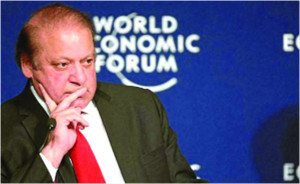
Davos or Charsada
Sir,
For the PM of Pakistan to be seen delivering a speech from written text in Davos to an audience compromising mostly members of his delegation and Pakistani community, instead of being in Pakistan visiting next of kin of the victims of the Charsadda massacre, it simply saddening. How can the PM expect foreign investors to invest in Pakistan when the bulk of his own investments are outside this country? It seems the PM’s samdi has assumed the same role as that of Asif Zardari’s sisters, especially Faryal Talpur, and is inflicting same damage to his reputation and governance. The rise from Lambretta or Vespa to Lamborghini involves many white-collar crimes and is made apparent by huge properties and assets in Dubai.
Nothing is more important than the people of Pakistan, who are sole the beneficiaries and the reason for the state of Pakistan to exist. All institutions of state including parliament, PM and his cabinet, armed forces and civil bureaucracy are there to serve the people.
An elected PM gets his powers from the constitution to serve and protect the people and act as the guardian of the national exchequer. It is his job to ensure that all citizens enjoy equal rights and privileges and are levied uniform taxes. There is no law that gives the PM authority to give yet another tax amenity to known tax evaders, instead of punishing them. Is the state trying to prove that only “fools pay taxes” in this country?
The moment the PM deviates from his mandatory constitutional obligation, he violates the constitution in the same manner as a military usurper does when he declares martial law. Abuse of power acquired through ballot is as much a sin as abuse of power gotten from the barrel of a gun.
Aneela Chandio,
Sukkur.