

Plenty for everyone
Sir,
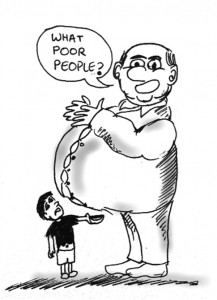
It is a known fact that Pakistan is one of the richest countries of the world in terms of natural resources. It has been endowed with gigantic reserves of coal, gas, gemstones, copper and gold. Other resources include oil, iron, titanium and aluminium which are raw material for a growing economy. It is unfortunate that these resources have never been fully exploited.
This extremely disappointing state of affairs is a result of critical flaws in governance. Except for some very brief spells of economic success, Pakistan’s development graph has mostly been going down. Political instability, deteriorating law and order and rampant corruption are major hurdles in the development of the country’s natural resources.
In spite of these resources, Pakistan continues to confront significant trade deficit and its reliance on foreign assistance continues grow. An acute energy crisis and rapidly declining foreign investment add to the burgeoning economic predicaments of the country.
In order to be able to attain its developmental goals and bring prosperity to the downtrodden masses of the country, a massive overhaul of the existing system of poor governance will have to be done. Sincere and honest endeavours will have to be made to fully exploit the country’s phenomenal natural resources to build up a very strong financial edifice and to drastically reduce its dependence on foreign assistance. Those at the helm of affairs in the country must clearly understand that there can be no compromise at all on these issues.
M Fazal Elahi,
Islamabad.
Justice delayed – I
Sir,
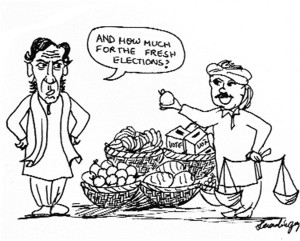
It is very strange to see two politicians who have been declared absconders by court freely carrying out political activities in and outside Pakistan. The whereabouts of both are known to everyone and they are not in hiding. Why is the capital police not fulfilling its responsibility to arrest the absconders?
Any law-abiding citizen will call this a joke with the nation. I suggest in good faith to the federal interior minister to take a very serious note of this and ensure appropriate action to establish the supremacy of law to strengthen democracy in Pakistan.
I am very much of view that If Imran Khan succeeds on November 30, 2014 in holding a large procession in Islamabad, then there will be a midterm general election in September or October 2015. Otherwise, he could see an in-house change in the Khyber Pakhtunkhwa Assembly in March or April 2015. This is my political analysis, irrespective of who is right or wrong. Here, a basic rule must be kept in mind that court orders and decisions must be respected by all state departments and the country’s executive head must ensure this. It is the primary responsibility of the police to implement the court’s orders. The judiciary can only be seen as independent if it makes decisions of merit, irrespective of the position of the person who is being accused.
Khalid Mustafa,
Islamabad.
Justice delayed – II
Sir,
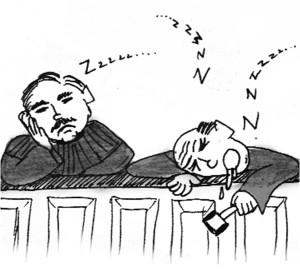
I had filed a suit in Sindh High Court wherein I had also prayed for an injunction against the defendant trying to illegally dispose of my valuable property. I was shocked to learn that instead of taking my urgent application in earnest, the court has deferred it for two months. That speaks volumes about how our courts are operating and the state of rule of law and justice in our country. At least for the common man.
It goes without saying that justice delayed is justice denied. Such inordinate delay in such a case is very likely to render the stag dead while the grass grows.
Mazhar Butt,
Karachi.
Soft power
Sir,
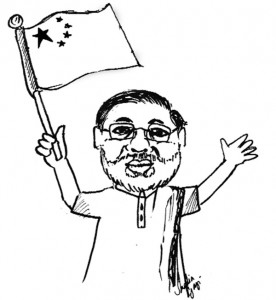
Two emerging powers coming together in the interest of regional peace is not a common spectacle. The growing economic partnership between India and China is an unforeseen development. It is an indication that states are getting mature and have started taking rational decisions. Due to their emerging ties, the regional atmosphere will eventually head in a positive direction. Functionalism is taking up colors in the Asian continent whereby the two states are translating their interdependence into cooperation.
India and China, the world’s two most populous countries, have been engaged in the biggest border conflict since decades, which has resulted in frictional relations between them. But recently, the arrival of Chinese President Xi Jinping to India on 17th September 2014 has not only gained regional attention but global attention too, due to the fact that it was a historic and significant visit – the first visit of a Chinese president to India in 8 years. Both states, being the world’s factory and global service provider respectively, have the aptitude for partnership in high technology, investment and financial services. The two Asian giants have decided to expand and escalate the cooperation between them by discussing and then resolving, areas of common concerns. The topics under discussion included investment of billions of US dollars in India in the next 5 years, cooperation in agricultural, IT and pharmaceuticals products, updating existing railways and development of infrastructure in India, all of which will eventually turn their conflicting relations to friendly ones.
Moreover, both of them have decided to contribute in the Silk Road Economic Belt, to speed up the construction of Bangladesh-China-India-Myanmar (BCIM) Economic Corridor to connect Kunming with Kolkata, to facilitate each other in regional and sub-regional cooperation, and to instigate regional growth which will in turn open the door of benefits to all people in the region. In short, the mainly focused issues were of infrastructure, energy and water, constituting 20 expected agreements. China has also agreed to locate and invest in an industrial park in Gujrat state which is also a signal that Prime Minister Narendra Modi’s goal of linking India to East Asian supply networks is in compliance with China.
Due to the vivid shift in the economy since last several decades, China has been pursuing soft power. The term “soft power” has nowhere been as extensively used as in China and it is now a familiar story to all that China is strongly undertaking efforts to enhance its image in the international system. Its “face” is of much concern and a matter of prestige. Consequently, China would not want any other power in the same region to rise against it and therefore in contrast to US hard power strategy it is using diplomacy and soft power to turn its regional rival and competitor into a friend. This appealing image of China is a threat to US interests and policies in the Asian region.
Both the Asian hegemons have their particular interests in the economic and bilateral relations. China on one hand wants its economy to flourish and this can occur if there will be maintenance of peace in the region. On the other, it is developing relations with all other countries including Russia, in order to reduce the influence of Japan, Taiwan and US in the region. China intends for Asian states to subordinate their interests to those of China, instead of looking to the US for their regional solutions.
India also wants to lessen the US influence in the region and it wants to counter China too, but it has a more liberal approach. In contrast to Japan’s hostile policy towards China, India is dwelling more upon cooperation. Only in this way, it believes, can US impact in the region be reduced, eventually leading to the rise of an absolute regional hegemon.
In addition to the geostrategic and geopolitical significance of Asia, it has four nuclear powers. Security is the prime concern in this nuclear armed belt because any escalating conflict can lead to the outbreak of war. The chances of war will be less if there is peace and security in Asia. When two regional hegemons will cooperate, their border conflicts will eventually find a way to resolution.
Where there is cooperation, there is interdependence, China and India being interdependent, will succeed in cooperating.
Iqra Kabir,
Rawalpindi.
What it takes
Sir,
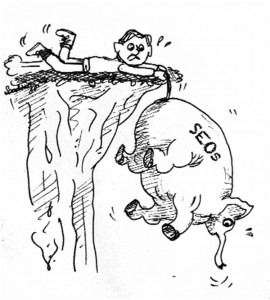
Pakistan’s state-owned enterprises have been deteriorating over years because of our refusal to hire the most qualified team of professionals with moral integrity and specialization in relevant fields, instead of jacks of all trades.
Every government talks about promoting education, or keeping abreast with latest technological advances, or developing a corporate system, but ends up appointing semi-literate cronies to head state-owned enterprises.
For instance, regulating power distribution and its economical production is a specialized field. Improvements can only be made if the latest technological advances are incorporated to check theft, with a credible and efficient distribution system capable of absorbing an increase in capacity, after adopting the most cost effective mode of production.
Similarly, it is surprising that successive governments think that piloting skills are sufficient to help turn around Pakistan International Airlines, although the national carrier’s annual balance sheets prove otherwise. A professional commercial pilot is as qualified to head an airline as an engine driver is to head Railways.
The sole exception was Air Marshall Nur Khan, a man with impeccable integrity who, given powers to hire and fire and knowing his limitations, hired the best qualified team to handle management. With technological advances in aviation, it requires specialists in fields of marketing, finance, procurement and automation, with fool proof checks and balances to avoid pilferage, and not just a tough guy.
Rahat Siddiqi,
Karachi.
Advice for Obama
Sir,
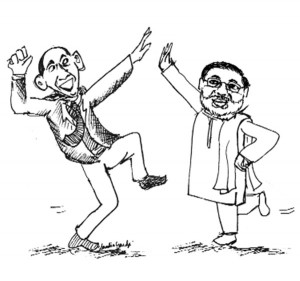
US President Barack Obama will be the chief guest at the Republic Day parade in India’s capital New Delhi on January 26, 2015. India is especially pleased because being the world’s economic and military superpower, the US can benefit India in many ways. But Obama will fall into the trap of communal Hindus if he is not careful, because India under Prime Minister Modi (under the influence of the Sangh Parivar) is bound to exploit Obama’s visit to further the cause of Hindu communalism. Therefore Obama should do the following, before coming to Delhi.
In the modern world, freedom of expression has acquired a wider meaning. Obama said at the UN in 2012: “At a time when anyone with a cell phone can spread offensive views around the world with the click of a button, the notion that we can control the flow of information is obsolete.” He said further: “Americans have fought and died around the globe to protect the right of all people to express their views, even views that we profoundly disagree with. We do not do so because we support hateful speech, but because our founders understood that without such protections, the capacity of each individual to express their own views and practice their own faith may be threatened. We do so because in a diverse society, efforts to restrict speech can quickly become a tool to silence critics and oppress minorities.”
The message has not reached India. So-called hate speech by Hindus and Muslims is highlighted in the Indian media, which triggers communal passions and even violence. The communally prejudiced Indian state still harasses and persecutes people, especially minorities, in the name of hate speech. Even the Sikhs and Jains are scared to move the court for getting justice.
Only Muslim and not Hindu terrorists and rioters are booked and prosecuted in India. A Muslim politician pointed out that Hindus found guilty in Sri Krishna Commission Report on the 1992-93 riots in Mumbai, after the demolition Babri Masjid, have not been prosecuted so far.
Even Hindu sects of lower castes are systematically harassed and persecuted by upper caste-majority-Hindus.
Obama can gauge the anger of Sikhs and Muslims against the communally prejudiced Indian State by looking at a number of recent cases. He should also understand that if professedly moderate PM Vajpayee (without absolute majority of BJP in Loksabha) could be used by the Sangh Parivar for carrying out the 2002 Gujarat massacre of thousands of innocent Muslims, Modi will be much worse.
Therefore, before coming to India, Obama should ask New Delhi to repeal laws against freedom of expression and ask US embassies and consulates in India to conduct detailed studies on the communal prejudices of the Indian state. Otherwise, Modi is bound to exploit Obama’s visit to further the cause of communalism.
Hem Raj Jain,
Bengaluru.