

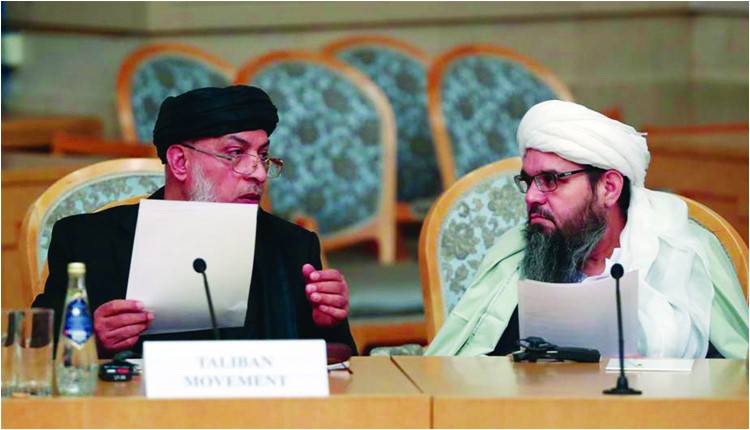
The on-and-off peace talks between the Taliban and the United States, the decision to withdraw more than half of American embassy officials from Kabul this month and the agreement last week between US, Russia and China to jointly work with Afghanistan’s neighbours to end the war have raised hopes about the end game in the 18-year-old Afghan conflict. But how realistic is the optimism?
The Taliban have refused ceasefire and refused to talk with Ashraf Ghani’s government. They have demanded only a timetable for the withdrawal of US troops. The stalemate continues as the Taliban control rural areas and the government controls the cities, while casualties continue to mount and opium production and trade flourishes.
The optimism is predicated on two assumptions: first, that the Taliban worldview has changed since they were overthrown in 2001, and that they have the will and capacity to no longer allow Afghan soil to be used by militants. Second, that Pakistan’s Afghan policy has also changed, and that a stable Afghanistan is more important for Pakistan than a sovereign Afghanistan pursuing normal relations with India (which are not directed against Pakistan).
Both Al Qaeda and the Islamic State retain significant presence in Afghanistan, the latter also having claimed responsibility for some attacks inside the country. The Taliban may not allow the Afghan soil to be used by militants of the Islamic State and Al-Qaeda for attacks like the 9/11, but do they also have the capacity?
Given the opacity of tribal regions along the border, the possibility of the IS and Al Qaeda relocating cannot be totally ruled out. It is here that Pakistan’s role becomes central. It is this factor that partly explains the decision by the US, China and Russia to “persuade Afghanistan neighbours for support.”
Despite successes in curbing militancy, the erstwhile tribal regions still largely remain no-go areas for members of the parliament and the media. The sealed and barricaded tribal areas have not helped in countering criticism about safe havens for militants.
It has been an undeclared state policy to not accept any Kabul government perceived to be friendly with India. A fragmented, Pakistan-installed weak regime in Kabul is what Islamabad has been seeking for decades. In the 1980s, we demanded disbanding of the government of the People’s Democratic Party in Kabul. Our Afghan policy has been based on a zero-sum game with India. To justify this, the Indian threat is also exaggerated - as in the case of claims that India has built 24 consulates in Afghanistan.
It was, therefore, no surprise when recently Prime Minister Imran Khan called for replacing the Kabul government, saying it was a hurdle to peace in the region. It is yet to be seen whether his subsequent pledge of neutrality is a strategic shift in policy, or a tactical diversion against mounting criticism.
The proxy Taliban’s refusal to talk peace with the Afghan government is also similar to Pakistan’s refusal to talk directly with the Kabul government in the past. Remember the special UN envoy Diego Cardovez shuttling between Kabul and Islamabad as Pakistan refused to talk directly with Afghanistan. During talks in Switzerland, we invented the notion of “proximity talks” and Cardovez was made to shuttle from room to room in Geneva because we did not want direct talks.
The “proximity talks” led to Geneva Accords and the Soviet withdrawal no doubt. Indirect talks by nature are not broad-based. So the agreement in Geneva hammered out in indirect talks also resulted in civil war and huge geopolitical chaos. The result of the Taliban shutting out the government in Kabul or engaging them in indirect talks is unlikely to be any different.
Seeking to keep Ashraf Ghani’s government out of the talks looks like a ‘minus one’ formula being applied in Afghanistan. If it failed in Pakistan, it is unlikely to succeed in Afghanistan
In our national security calculus, a weak, India-averse Afghanistan is more important than a stable Afghanistan. Fearing Afghanistan’s relations with India is wrong. No other country can compete with Pakistan in terms of better ties with Afghanistan.
As a result of our India-centric policy, we have denied trade with Afghanistan. With fencing of the border, trade has diminished further. Afghanistan and India have started trading via Chahbahar and Pakistan is losing out in the huge Central Asian markets. Pursuing a weird geostrategic policy has cost Pakistan greatly in terms of economic opportunities.
The military’s footprints and militarisation of the tribal areas must come to an end. Zulfikar Ali Bhutto, in his book If I am Assassinated, had said that when armies expand, three consequences follow. They either expand their territory or they cut their size, or they continue the status quo. In the third scenario, they risk withering under their own weight.
Bhutto said that expansion was no option because there was no space and cutting size would be resisted and so Pakistanis were condemned to continue with the status quo.
A precipitous withdrawal of the US without a genuine intra-Afghan dialogue, insistence on pursuing an India-centric policy, continued militarisation and tribal regions as no-go areas dampen optimism. Apprehensions of more chaos, instability and implosion seem much more realistic.
The writer is a former member of Foreign Relations Committee in the Senate.
The Taliban have refused ceasefire and refused to talk with Ashraf Ghani’s government. They have demanded only a timetable for the withdrawal of US troops. The stalemate continues as the Taliban control rural areas and the government controls the cities, while casualties continue to mount and opium production and trade flourishes.
The optimism is predicated on two assumptions: first, that the Taliban worldview has changed since they were overthrown in 2001, and that they have the will and capacity to no longer allow Afghan soil to be used by militants. Second, that Pakistan’s Afghan policy has also changed, and that a stable Afghanistan is more important for Pakistan than a sovereign Afghanistan pursuing normal relations with India (which are not directed against Pakistan).
Both Al Qaeda and the Islamic State retain significant presence in Afghanistan, the latter also having claimed responsibility for some attacks inside the country. The Taliban may not allow the Afghan soil to be used by militants of the Islamic State and Al-Qaeda for attacks like the 9/11, but do they also have the capacity?
Given the opacity of tribal regions along the border, the possibility of the IS and Al Qaeda relocating cannot be totally ruled out. It is here that Pakistan’s role becomes central. It is this factor that partly explains the decision by the US, China and Russia to “persuade Afghanistan neighbours for support.”
Despite successes in curbing militancy, the erstwhile tribal regions still largely remain no-go areas for members of the parliament and the media. The sealed and barricaded tribal areas have not helped in countering criticism about safe havens for militants.
It has been an undeclared state policy to not accept any Kabul government perceived to be friendly with India. A fragmented, Pakistan-installed weak regime in Kabul is what Islamabad has been seeking for decades. In the 1980s, we demanded disbanding of the government of the People’s Democratic Party in Kabul. Our Afghan policy has been based on a zero-sum game with India. To justify this, the Indian threat is also exaggerated - as in the case of claims that India has built 24 consulates in Afghanistan.
It was, therefore, no surprise when recently Prime Minister Imran Khan called for replacing the Kabul government, saying it was a hurdle to peace in the region. It is yet to be seen whether his subsequent pledge of neutrality is a strategic shift in policy, or a tactical diversion against mounting criticism.
The proxy Taliban’s refusal to talk peace with the Afghan government is also similar to Pakistan’s refusal to talk directly with the Kabul government in the past. Remember the special UN envoy Diego Cardovez shuttling between Kabul and Islamabad as Pakistan refused to talk directly with Afghanistan. During talks in Switzerland, we invented the notion of “proximity talks” and Cardovez was made to shuttle from room to room in Geneva because we did not want direct talks.
The “proximity talks” led to Geneva Accords and the Soviet withdrawal no doubt. Indirect talks by nature are not broad-based. So the agreement in Geneva hammered out in indirect talks also resulted in civil war and huge geopolitical chaos. The result of the Taliban shutting out the government in Kabul or engaging them in indirect talks is unlikely to be any different.
Seeking to keep Ashraf Ghani’s government out of the talks looks like a ‘minus one’ formula being applied in Afghanistan. If it failed in Pakistan, it is unlikely to succeed in Afghanistan
In our national security calculus, a weak, India-averse Afghanistan is more important than a stable Afghanistan. Fearing Afghanistan’s relations with India is wrong. No other country can compete with Pakistan in terms of better ties with Afghanistan.
As a result of our India-centric policy, we have denied trade with Afghanistan. With fencing of the border, trade has diminished further. Afghanistan and India have started trading via Chahbahar and Pakistan is losing out in the huge Central Asian markets. Pursuing a weird geostrategic policy has cost Pakistan greatly in terms of economic opportunities.
The military’s footprints and militarisation of the tribal areas must come to an end. Zulfikar Ali Bhutto, in his book If I am Assassinated, had said that when armies expand, three consequences follow. They either expand their territory or they cut their size, or they continue the status quo. In the third scenario, they risk withering under their own weight.
Bhutto said that expansion was no option because there was no space and cutting size would be resisted and so Pakistanis were condemned to continue with the status quo.
A precipitous withdrawal of the US without a genuine intra-Afghan dialogue, insistence on pursuing an India-centric policy, continued militarisation and tribal regions as no-go areas dampen optimism. Apprehensions of more chaos, instability and implosion seem much more realistic.
The writer is a former member of Foreign Relations Committee in the Senate.