

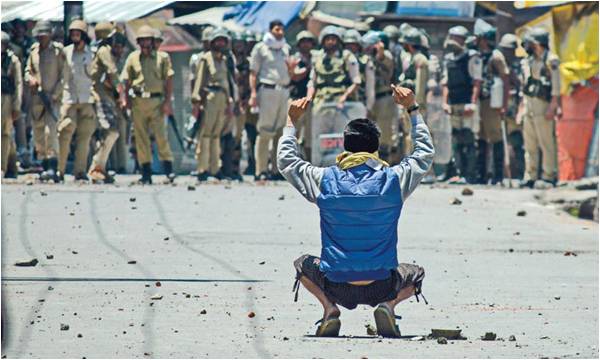
Kashmir University has rarely seen such a volatile situation on the campus in recent times as it has been witnessing for the last week or so. The students have turned violent. There was aerial firing, and the authorities had to shut down the university for many days. In Kashmir’s unrelenting conflict of over 25 years, this is perhaps for the first time that the campus is behaving like this. The authorities must have failed in reassuring the student community that it was on their side.
The spate of violent protests started after a postgraduate student Muzamil Farooq was picked up by the police apparently for his links with a militant organization. His family and friends have denied the allegations.
Kashmir’s uncertain political situation has even otherwise hit the education sector with recurrent trouble inviting calls for shutdowns. But now that it was the admissions season at Kashmir University, the events have cast a shadow over academic activities.
KU authorities seem to be helpless, the state administration is silent and the students refuse to budge till Muzamil is released unconditionally. The situation in KU had a spiraling effect outside the campus as well. In solidarity with students, scores of youth protested in downtown Srinagar leading to a situation where police had to lob tear smoke shells, even in Jamia Masjid. This too was resented with a strike in Srinagar city on Saturday, as the separatist groups declared landing of shells inside the historic mosque as sacrilegious.
Whether the university authorities failed to control the situation in an amicable manner or not is not the question of debate here. It is much beyond the immediate solution to the problem. Even if Muzamil is released by police, it may not resolve the larger issues that trigger such situations. While the KU administration could have handled it better, police should also have come out with details about his alleged involvement. KU Vice Chancellor Khurshid Iqbal Andrabi is no doubt a scientist of international repute, but to administer a campus where mistrust and alienation is running so deep is a challenging task. He has also been left in lurch by the state government in this matter, which has worsened the situation.
Arresting a Kashmiri youth on charges whether proven or otherwise is not a new thing. It has been an inalienable part of the conflict for the last 25 years. But here there are two issues which are important for understanding the whole situation. One is that the political space for the youth, especially students, has been choked for long time and this simmering discontent had to come out at one point of time or the other. Second is that faith in the institutions of investigation has been lost long time ago.
The way the campus has denied space to student politics for decades, it certainly leaves open doors for more volatile response from the students. Since there is no formal structure in which students could articulate their viewpoint, the discourse is destined to be “hijacked” or “misused” by vested interests. Denying the students genuine political space on the campus is something that has already built walls between the administration and the student community. A communication gap has further widened the gulf and even on the issue of the arrest of a student there is no engagement between the two sides.
Contrary to this, the campus in the past has been used for promoting mainstream politics. Congress vice president Rahul Gandhi had made the university campus his favourite forum in previous years to hold closed-door sessions with students. The local unit of National Students Union of India (NSUI) was also allowed on the campus. But the right to have a Union of, by and for the students has been banned by the authorities. Education Minister Naeem Akhtar recently hinted at allowing such a union but the authorities immediately retracted.
There is no denying the fact that Kashmir has been witnessing a complex political situation and a union on the campus would reflect a particular strand of politics as well. But that does not mean that denial of political space to students was a solution to counter the “Azadi” discourse in Kashmir. We otherwise have unions and associations which articulate the same viewpoint. Kashmir Bar Association’s viewpoint vis-a-vis “freedom struggle” is well known. They do practice law under the Indian constitution, but they do not recognize anything else. The bar also does not join functions where judges are facilitated. They echo each and everything the separatists say vis-a-vis Kashmir. Even the Employees Joint Action Committee (EJAC) that represents 450,000 government employees does the same thing. Its president Abdul Qayoom Wani was recently seen sitting by the side of hard-liner Hurriyat leader Syed Ali Geelani when he had called meeting to decide about the future strategy of the struggle.
Moreover, the grounds of Muzamil’s arrest are summarily rejected by the people. This is because of the fact that over a period of time people have lost faith in the institutions run by the state. Look at the recent incidents in Sopore where mobile towers were attacked and some civilians were killed. The spontaneous reaction by an average Kashmiri was that it was the “handiwork of agencies”. There are hardly any buyers for the state's version of events. So what is given as the ground for justifying Muzamil’s arrest is seen as a “concocted” story unless the police comes out with unchallenged evidence. Credibility of institutions has been questioned like this time and again and the incidents of fake encounters and random arrests have dented the reputation of the state.
So in this case, the issue of arrest alone should not be seen as the cause but the larger issue of choking the space to articulate and agitate must be kept in mind. Unless the state opens up such spaces, even if the issue of Muzamil's arrest is resolved, such situations cannot be avoided in future because the gap between the student community and the university authorities continues to exist. The sanctity of the university as the highest seat of learning and academics must be maintained at all costs.
The author is a veteran journalist from Srinagar and the editor-in-chief of Rising Kashmir
The spate of violent protests started after a postgraduate student Muzamil Farooq was picked up by the police apparently for his links with a militant organization. His family and friends have denied the allegations.
Kashmir’s uncertain political situation has even otherwise hit the education sector with recurrent trouble inviting calls for shutdowns. But now that it was the admissions season at Kashmir University, the events have cast a shadow over academic activities.
KU authorities seem to be helpless, the state administration is silent and the students refuse to budge till Muzamil is released unconditionally. The situation in KU had a spiraling effect outside the campus as well. In solidarity with students, scores of youth protested in downtown Srinagar leading to a situation where police had to lob tear smoke shells, even in Jamia Masjid. This too was resented with a strike in Srinagar city on Saturday, as the separatist groups declared landing of shells inside the historic mosque as sacrilegious.
Whether the university authorities failed to control the situation in an amicable manner or not is not the question of debate here. It is much beyond the immediate solution to the problem. Even if Muzamil is released by police, it may not resolve the larger issues that trigger such situations. While the KU administration could have handled it better, police should also have come out with details about his alleged involvement. KU Vice Chancellor Khurshid Iqbal Andrabi is no doubt a scientist of international repute, but to administer a campus where mistrust and alienation is running so deep is a challenging task. He has also been left in lurch by the state government in this matter, which has worsened the situation.
Arresting a Kashmiri youth on charges whether proven or otherwise is not a new thing. It has been an inalienable part of the conflict for the last 25 years. But here there are two issues which are important for understanding the whole situation. One is that the political space for the youth, especially students, has been choked for long time and this simmering discontent had to come out at one point of time or the other. Second is that faith in the institutions of investigation has been lost long time ago.
The way the campus has denied space to student politics for decades, it certainly leaves open doors for more volatile response from the students. Since there is no formal structure in which students could articulate their viewpoint, the discourse is destined to be “hijacked” or “misused” by vested interests. Denying the students genuine political space on the campus is something that has already built walls between the administration and the student community. A communication gap has further widened the gulf and even on the issue of the arrest of a student there is no engagement between the two sides.
Contrary to this, the campus in the past has been used for promoting mainstream politics. Congress vice president Rahul Gandhi had made the university campus his favourite forum in previous years to hold closed-door sessions with students. The local unit of National Students Union of India (NSUI) was also allowed on the campus. But the right to have a Union of, by and for the students has been banned by the authorities. Education Minister Naeem Akhtar recently hinted at allowing such a union but the authorities immediately retracted.
There is no denying the fact that Kashmir has been witnessing a complex political situation and a union on the campus would reflect a particular strand of politics as well. But that does not mean that denial of political space to students was a solution to counter the “Azadi” discourse in Kashmir. We otherwise have unions and associations which articulate the same viewpoint. Kashmir Bar Association’s viewpoint vis-a-vis “freedom struggle” is well known. They do practice law under the Indian constitution, but they do not recognize anything else. The bar also does not join functions where judges are facilitated. They echo each and everything the separatists say vis-a-vis Kashmir. Even the Employees Joint Action Committee (EJAC) that represents 450,000 government employees does the same thing. Its president Abdul Qayoom Wani was recently seen sitting by the side of hard-liner Hurriyat leader Syed Ali Geelani when he had called meeting to decide about the future strategy of the struggle.
Moreover, the grounds of Muzamil’s arrest are summarily rejected by the people. This is because of the fact that over a period of time people have lost faith in the institutions run by the state. Look at the recent incidents in Sopore where mobile towers were attacked and some civilians were killed. The spontaneous reaction by an average Kashmiri was that it was the “handiwork of agencies”. There are hardly any buyers for the state's version of events. So what is given as the ground for justifying Muzamil’s arrest is seen as a “concocted” story unless the police comes out with unchallenged evidence. Credibility of institutions has been questioned like this time and again and the incidents of fake encounters and random arrests have dented the reputation of the state.
So in this case, the issue of arrest alone should not be seen as the cause but the larger issue of choking the space to articulate and agitate must be kept in mind. Unless the state opens up such spaces, even if the issue of Muzamil's arrest is resolved, such situations cannot be avoided in future because the gap between the student community and the university authorities continues to exist. The sanctity of the university as the highest seat of learning and academics must be maintained at all costs.
The author is a veteran journalist from Srinagar and the editor-in-chief of Rising Kashmir