

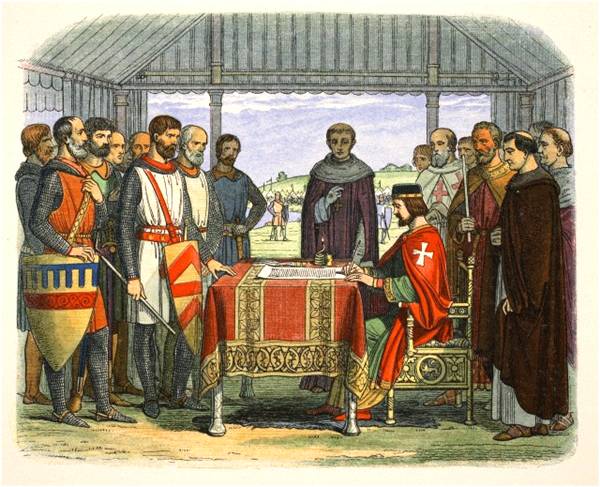
As this is being written I am returning from a three-week visit to Great Britain. The timing of the visit was fortuitous; I did not plan it this way, but the three weeks coincided with the apex of the celebration of 800th anniversary of the Magna Carta. That iconic document, of which the British are very proud, at least on its centennial anniversaries, and celebrate as the basis for the legal principle of the rule of law, an established principle now in some countries and an aspirational one in many others. It was the Magna Carta which, to my knowledge, first put forward (indirectly) the concept that no person, even a monarch, is above the law. This was codified in a later version of the Magna Carta in the late 13thcentury, probably the earliest that revolutionary concept was made into law, however erratically it was applied in the ensuing centuries. Americans are equally, though perhaps derivatively, proud of the Magna Carta as we believe the very general, somewhat ambiguous provisions in the document regarding the rights of citizens and guarantees of fairness to be foundation of our basic freedoms, and which we (unlike the British) have enshrined and elaborated in the first ten amendments of our constitution – what we call the Bill of Rights.
But one has to wonder how, and why, a document that was signed under duress by a temporarily down-on-his-luck King and a set of powerful feudal Barons who didn’t want to pay higher taxes and had the upper hand for a short time, that was in effect for only a couple of months before the King reneged and the Pope declared it null and void, and perhaps most importantly, that had nothing at all to do with at least 90 percent of the population, remains after 800 years the one we look to as the foundation and the beginning of our free and democratic societies. Only two provisions from this very long document remain in effect, and they are as ambiguous and general as to have almost no application in current law. Clauses 39 and 40 of the original document read in translation from Latin, “no free man shall be seized or imprisoned, of stripped of his rights in possessions, or outlawed or exiled, or deprived of his standing in any other way, nor will we proceed with force against him, or send others to do so, except by the lawful judgement of his equals, or by the law of the land. To no one will we sell, to no one deny or delay right or justice.”
These foundational phrases originated in a meadow near London called Runnymede as a compromise between King John and the great feudal Barons of the day who felt the King was taxing them too much. It was nothing close to democracy in action, but instead a power struggle between a powerful small class of wealthy men and a more powerful King who found himself financially strapped, and in great need for money to finance the wars he insisted on waging to recover the areas in France that the British crown had ruled and lost. “Free man” not only, by definition, excluded half of the population, but it excluded the vast majority of males who were rural peasants.
In fact, the original Magna Carta of June 1215, survived only a couple of months. The King reneged as soon as he could with the help of a Papal Bull which declared the law null and void because it was obtained under duress. The Pope didn’t like weakening Kingly power any more than the King. The document was issued several times in different versions during the 13th century by John’s son, Henry III, who took the throne at the age of 9 in 2016 and needed the Barons’ support after his father had died from dysentery following his celebration of a victory in these same wars. However, its codification didn’t occur until 1297 when Edward I issued the final version –again to help increase the tax take. It has remained in effect (sort of) since then, although most of its provisions have been superseded by Parliamentary legislation.
It seems to me, however, that there are important aspects to the evolution of the concepts that spring from the Magna Carta that are sometimes overlooked or at least understated. One concept is the right to revolution which asserts that the people have the right to overthrow a government that is not serving their common interests. This shows up sporadically in world history as early as in ancient China and most notably in Hungary about the same time as the Magna Carta – The “Golden Bull” of 1225 – which, who knows, could have been modeled on the Magna Carta. This becomes more prominent in the 17th and 18 centuries with the English American and French revolutions.
The other, better known concept to which the Magna Carta has contributed is the theory of social contract. The Magna Carta may have been the first time the idea of a social contract was institutionalized as the basis for national formation, for the governance of a nation. This theory really addresses how human live together, how rulers and ruled unite for the betterment of a nation, basically how nations are governed. Thought on this goes back at least to Plato and the Buddhist Empire of Ashoka.
Social contract has become more important in the modern world. There are really three variants of modern Social Contract theory, by three celebrated 18ty century political theorists, and they continue to compete in the 21st century. Thomas Hobbes, developed his social contract theory on the basis of his assumption that the environment in which people lived, what he called the state of nature, was brutish and nasty where life was short, and that that the ruled would choose to accede to the ruler most of their individual rights for the protection the rulers could provide. This remains the basis of modern authoritarian thought. John Locke, on the other hand, believed that there are inalienable rights that people cannot willingly give up, but they will delegate to the government their right to self-defense. Thus the government derives is just powers from the consent of the governed. The government’s role then is to protect the exercise of those rights while undertaking self-defense. Locke was the grandfather of the American Constitution and Declaration of Liberty, and the intellectual father of modern democracy. Jean-Jacques Rousseau thought a social contract required a “great leader” necessary for a creation of a general will to which the people must subordinate themselves. This is a collectivist vision which contrasts with that of Hobbes and Locke, and inspired the collectivist political choices of the last century. In the 21st century, as I have pointed out, Hobbesian authoritarianism seems to be winning additional adherents, while the Locke democratic version of the social contract loses steam as modern democracies seem unable to cope with the 21st century forces of change. The Rousseau collectivist version ran out of steam in the last century.
But one has to wonder how, and why, a document that was signed under duress by a temporarily down-on-his-luck King and a set of powerful feudal Barons who didn’t want to pay higher taxes and had the upper hand for a short time, that was in effect for only a couple of months before the King reneged and the Pope declared it null and void, and perhaps most importantly, that had nothing at all to do with at least 90 percent of the population, remains after 800 years the one we look to as the foundation and the beginning of our free and democratic societies. Only two provisions from this very long document remain in effect, and they are as ambiguous and general as to have almost no application in current law. Clauses 39 and 40 of the original document read in translation from Latin, “no free man shall be seized or imprisoned, of stripped of his rights in possessions, or outlawed or exiled, or deprived of his standing in any other way, nor will we proceed with force against him, or send others to do so, except by the lawful judgement of his equals, or by the law of the land. To no one will we sell, to no one deny or delay right or justice.”
These foundational phrases originated in a meadow near London called Runnymede as a compromise between King John and the great feudal Barons of the day who felt the King was taxing them too much. It was nothing close to democracy in action, but instead a power struggle between a powerful small class of wealthy men and a more powerful King who found himself financially strapped, and in great need for money to finance the wars he insisted on waging to recover the areas in France that the British crown had ruled and lost. “Free man” not only, by definition, excluded half of the population, but it excluded the vast majority of males who were rural peasants.
The original Magna Carta of June 1215 survived only a couple of months
In fact, the original Magna Carta of June 1215, survived only a couple of months. The King reneged as soon as he could with the help of a Papal Bull which declared the law null and void because it was obtained under duress. The Pope didn’t like weakening Kingly power any more than the King. The document was issued several times in different versions during the 13th century by John’s son, Henry III, who took the throne at the age of 9 in 2016 and needed the Barons’ support after his father had died from dysentery following his celebration of a victory in these same wars. However, its codification didn’t occur until 1297 when Edward I issued the final version –again to help increase the tax take. It has remained in effect (sort of) since then, although most of its provisions have been superseded by Parliamentary legislation.
It seems to me, however, that there are important aspects to the evolution of the concepts that spring from the Magna Carta that are sometimes overlooked or at least understated. One concept is the right to revolution which asserts that the people have the right to overthrow a government that is not serving their common interests. This shows up sporadically in world history as early as in ancient China and most notably in Hungary about the same time as the Magna Carta – The “Golden Bull” of 1225 – which, who knows, could have been modeled on the Magna Carta. This becomes more prominent in the 17th and 18 centuries with the English American and French revolutions.
The other, better known concept to which the Magna Carta has contributed is the theory of social contract. The Magna Carta may have been the first time the idea of a social contract was institutionalized as the basis for national formation, for the governance of a nation. This theory really addresses how human live together, how rulers and ruled unite for the betterment of a nation, basically how nations are governed. Thought on this goes back at least to Plato and the Buddhist Empire of Ashoka.
Social contract has become more important in the modern world. There are really three variants of modern Social Contract theory, by three celebrated 18ty century political theorists, and they continue to compete in the 21st century. Thomas Hobbes, developed his social contract theory on the basis of his assumption that the environment in which people lived, what he called the state of nature, was brutish and nasty where life was short, and that that the ruled would choose to accede to the ruler most of their individual rights for the protection the rulers could provide. This remains the basis of modern authoritarian thought. John Locke, on the other hand, believed that there are inalienable rights that people cannot willingly give up, but they will delegate to the government their right to self-defense. Thus the government derives is just powers from the consent of the governed. The government’s role then is to protect the exercise of those rights while undertaking self-defense. Locke was the grandfather of the American Constitution and Declaration of Liberty, and the intellectual father of modern democracy. Jean-Jacques Rousseau thought a social contract required a “great leader” necessary for a creation of a general will to which the people must subordinate themselves. This is a collectivist vision which contrasts with that of Hobbes and Locke, and inspired the collectivist political choices of the last century. In the 21st century, as I have pointed out, Hobbesian authoritarianism seems to be winning additional adherents, while the Locke democratic version of the social contract loses steam as modern democracies seem unable to cope with the 21st century forces of change. The Rousseau collectivist version ran out of steam in the last century.