


In my prior columns, I argued that the US seems to have reached the apogee of its status as a great power. I shared insights gleaned from talking with professionals in a variety of industries in America and the views of several well known scholars.
Some people disagreed with my assessment. They felt that the arrival of artificial intelligence (AI) would help override what they see as just being a bump in the road in America's journey. There is no doubt that AI is accomplishing solving complex problems at hypersonic speed. It has created a lot of economic optimism in America, and there is no doubt that AI will continue to add more to America’s economy. However, it is a mixed blessing at best.
First, AI is not unique to America. Other countries, notably China, are also developing their own AI capabilities. America’s great power status does not just depend on what it does with AI but also on what other countries do with their AI.
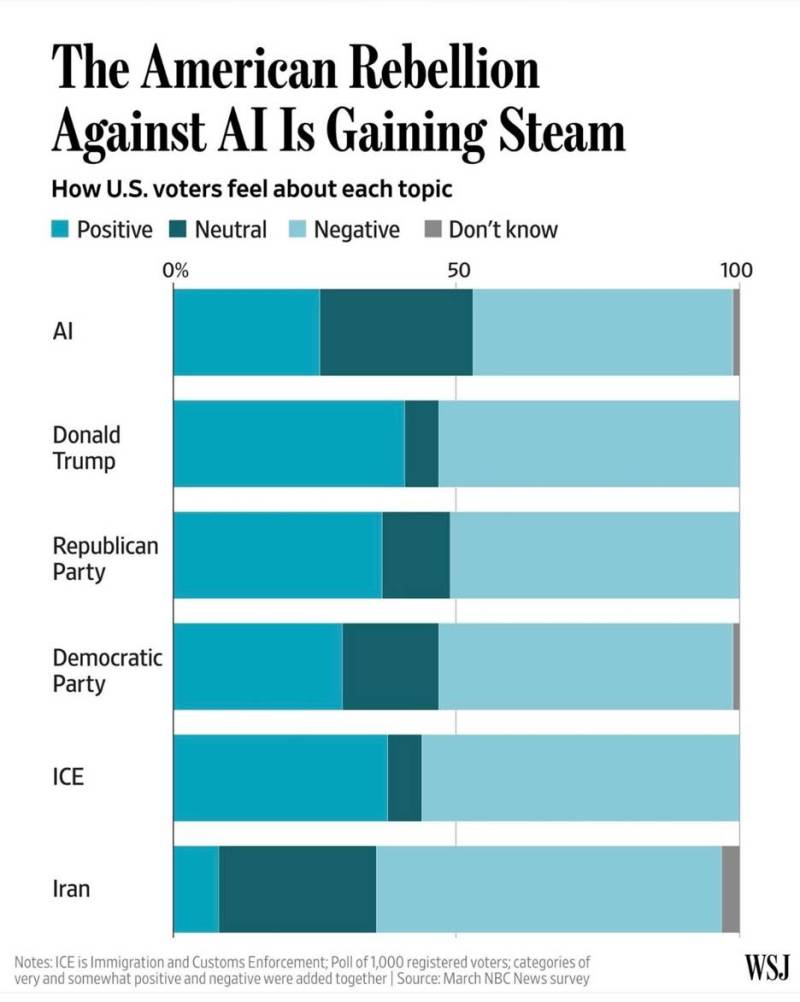
And, second, AI is eliminating jobs in many industries, including the Tech industries which have spawned AI. According to articles in the Wall Street Journal, while executives are highly optimistic about AI strengthening the broader economy, a majority of surveyed CEOs and the general public fear it will disrupt the job market and widen inequality. The WSJ recently published the results of a poll that was carried out by researchers at Stanford University and the University of California at Berkeley showing the unpopularity of AI.
AI is a force multiplier, not a magic wand – it can optimise systems, but it cannot inherently fix deep-seated domestic issues
A review of the stories that are being written about AI in the media shows that it has generated one of the most critical debates in modern geopolitics. Some analysts are putting forward an optimistic view that AI would fundamentally reshape economic, military, and soft power and preserve America’s great power status. But whether AI secures America’s great power status or accelerates its disruption depends entirely on how several core dynamics play out.
- The Economic Engine: Reversing the Productivity Slump
For decades, the American economy has struggled with sluggish productivity growth outside of the Tech sector. Manufacturing left the shores of the US in the 1980s and has yet to return. Some contend that AI will act like an elixir that will jolt the broader economy back into shape.
- The Optimistic View: Massive private AI investments (which surpassed $100 billion annually by the mid-2020s) could automate bureaucratic friction, revitalise manufacturing supply chains, and mitigate the economic impact of an aging workforce. A highly productive economy will generate the capital needed to maintain global influence.
- The Reality Check: This growth relies heavily on raw physical infrastructure. America faces massive bottlenecks in building data centres and upgrading a strained energy grid to support power-hungry AI models.
- The Military "Offset": Software Over Mass
In defence circles, the consensus is that a nation's military power will no longer be measured solely by the sheer number of its ships, tanks, or troops, but by the sophistication of its algorithms.
- Sustaining the Edge: Through initiatives tracing back to the "Third Offset Strategy," the US Department of Defence views AI as a way to preserve military overmatch. Autonomous drone swarms, AI-driven logistics, and predictive maintenance could allow a leaner US military to effectively counter larger conventional forces (such as China's naval expansion).
- The Vulnerability: If the US fails to lead in robust military AI deployment, it risks sudden obsolescence. Autonomous, inexpensive non-state weapons or highly advanced asymmetric cyber warfare could neutralise America's traditional, incredibly expensive hardware (like aircraft carriers).
- The Asymmetric Winner-Take-All Dynamic
A unique characteristic of the AI race is its tendency toward extreme centralisation. The massive computing power and data required to train frontier models mean that only a few entities—and likely very few nations—will capture most of AI's value.
Because the United States remains the birthplace and primary hub of frontier AI development, it is uniquely positioned to capture this “Great Divergence.” If American technology platforms remain the global standard, the US effectively exports its soft power, digital infrastructure, and governance standards to the rest of the world, cementing its status as an indispensable superpower.
The Structural Bottleneck
However, it is important to note that AI is a force multiplier, not a magic wand. It can optimise systems, but it cannot inherently fix deep-seated domestic issues—such as political polarisation, massive national debt, or an over-regulated domestic building sector, all of which are of great concern to Americans.
Thus, while AI has the potential to heavily offset declines in American power, technology alone cannot sustain a superpower. If American policy chokes off innovation through fragmented regulations, or if the physical infrastructure to power these systems cannot be built, the AI revolution could just as easily expose new vulnerabilities as it does strengths.
Even the Pope has weighed in with his concerns about AI. He warns that the “technocratic paradigm” can require that every choice be dictated exclusively by measuring efficiency and profits. Pope Leo said that the most powerful technology is not necessarily the best. AI can imitate and simulate the person, but it does not possess a moral conscience, empathy, or affective, relational or spiritual capabilities.
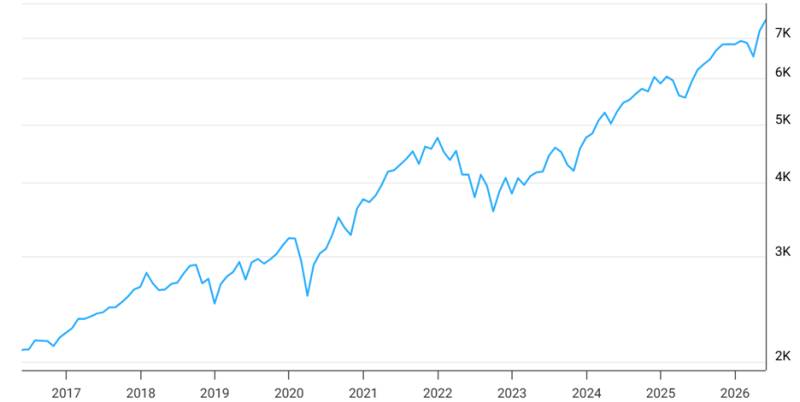
Andrew Ross Sorkin, a columnist with the New York Times, who has just published a book on the Great Depression of 1929, has voiced significant concerns about AI. He sees many parallels between the optimism that permeated the US in the years preceding the crash and the optimism that is building today around AI. The stock market in the US is at an all-time high, and shows no signs of slowing down. The graph shows the trajectory of the S&P 500 over the past decade.
However, similar optimism was evident between early 1928 and September 1929, during which the stock market increased by 90%, fuelled by the idea that everyone — not just elites — could join the financial boom.
In Sorkin’s view, the 1920s saw significant technological progress — radio and telecommunications revolutionised communication, much as AI is doing today. At the same time, consumer debt became commonplace, driven by companies like General Motors and Sears Roebuck, as well as banks such as National City (which later became Citigroup) that provided loans nationwide.
“You could literally walk into one of these brokerages, put down a dollar, and they would lend you $10,” he says. “And for a very nice stretch of time, it was like free money.”
Today’s AI frenzy feels eerily similar: powerful new technology, rising speculation, and receding guardrails. Andrew calls it “the magic ingredient for both a fabulous growth period and what often ends badly.” In 1929, it was margin loans. In 2008, subprime mortgages. “The question now,” he said, “is it the leverage in the system around the AI ecosystem?”
Today, AI-linked stocks now account for a record 45% of the S&P 500's total market cap. But Sorkin has doubts about AI’s ability to boost economic growth. He is not alone in holding such views. Other analysts note that AI hype is inflating valuations without clear evidence of broad economic productivity gains, echoing historical bubbles where optimism outpaced fundamentals.
AI's current economic impact is limited. Bank of America estimates AI currently lifts economy-wide productivity by only 0.1% per year. Goldman Sachs found no meaningful relationship between AI and productivity at the economy-wide level. AI can transform about 20% of workplace tasks, but only 23% are cost-effective to automate. Automated tasks save roughly 27% in labour costs, yielding a theoretical ceiling of 0.66% productivity gain.
Given all these conflicting data and views on the role of AI in the US economy, it’s unclear that AI will offset all the other political, social and economic forces that are slowly but surely pointing towards a decline in America’s great power status. Of course, America won’t lose its great power status in the next decade or two. It will take several decades, maybe even a century, before the US descends to a status akin to the UK's status in today’s world.