

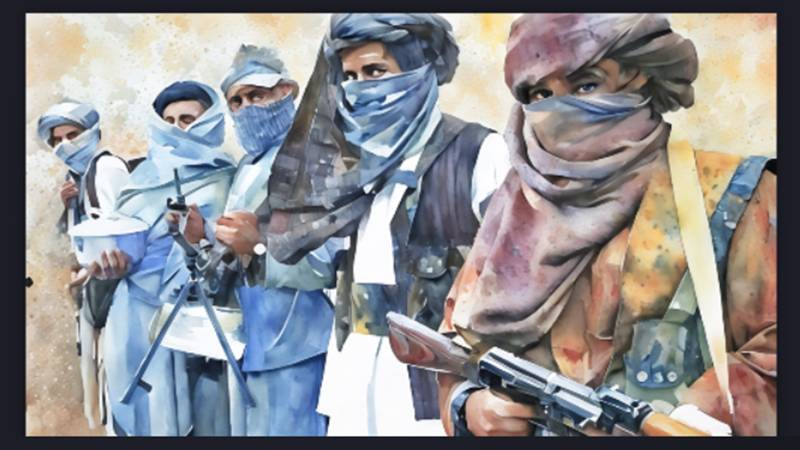
The recent purported video of the Islamic State Khorasan threatening Baloch militants has sent a shiver down the spine of all those who have been opposing religious fundamentalism, sectarianism and fanaticism. The video threatened secular Baloch nationalist elements of attacks, besides warning people against attending gatherings of activists who have been demanding the recovery of those falling victims to enforced disappearances.
Since the video appeared in the backdrop of statements issued by powerful elements of the state branding Dr Mahrang Baloch as an agent of India and describing her as a traitor, it has raised many questions. Many in Balochistan are left wondering if there is a systematic attempt to use fanatical elements of Pakistani society against the Baloch militants and rights activists. Many fear that such an approach will turn out to be very catastrophic, possibly plunging the country into an abyss of sectarian hatred besides further tearing down the social fabric of society.
An English historian wrote long time ago, “History is a lesson for those who want to learn and not for those who want to remain adamant.” It seems that the Pakistani establishment has learnt nothing from history. In the past fanatical elements were deployed in East Pakistan but failed to snuff out the nationalist struggle that culminated in the separation of that federating unit from the country. However, the bankrolling of extremist groups like Al Badar and Al Shams against the Bengalis further fuelled hatred against the country.
This should have served as a reminder but those who are enjoying the height of their power after subordinating the entire society consider it beneath their honour to even imagine such a situation where they have to carry out any type of introspection at all. They believe that they have suppressed the last trace of resistance by silencing the Pashtun Tahaffuz Movement and throwing Mahrang Baloch into jail. Their belief in their own invincibility has witnessed a tremendous boost after almost the entire media decided to be the lackey of the invisible Powers That Be.
But such an approach would not be without any harm. In reality it spells disaster for the entire country. It clearly indicates that the ghost of General Zia-ul-Haq is still haunting the country. Such an approach was used by Zia in Gilgit and Parachinar, inflicting deep wounds on the soul of the country. We are still grappling with the effects arising out of that insane approach.
Such an approach is likely to infuriate Iran, prompting it to shelter Baloch militants. Kabul would also view such an approach with great suspicion and might be forced to throw blanket support behind the TTP, which would further harm the interests of the country
Now the first question is: if Da’esh or ISIS were really powerful enough to establish such a foothold in Balochistan on their own, then why did they not prevent their annihilation in their powerbase located in Syria? Why did they face a terrible defeat in Iraq which resulted in this obnoxious ideology being exported to other parts of the world?
Unsatisfactory answers to such questions clearly indicate that it is not perhaps the throat-slitting jihadists who are hurling these threats to Baloch militants and rights activists, but it is their handlers that are orchestrating it all. Except for a few parts of Balochistan, many people in various areas of Balochistan, especially in the Baloch belt, are secular-minded. Sectarianism and fanaticism has never found any significant space there. It must be admitted that the influence of religion has witnessed a phenomenal surge over the decades because of the state policy to facilitate the preaching groups from Raiwind. But to claim that the Baloch population in general is ready to peddle the hate-filled Da’esh ideology flies in the face of reality.
The truth is that even today large sections of Baloch society are tolerant towards other religions. Hindus and other minorities have been living in the province for decades or perhaps centuries. They have never been targeted by nationalist elements, and even by militants. So, this all lends credence to speculations that under a well-calculated policy the province is being pushed towards religious and sectarian polarization. But the flames of religious zeal that the powerful are planning to fuel in the largest federating unit would not remain confined to the rocks, deserts and plains of the western province, but might incinerate several parts of the country.
Such an approach is likely to infuriate Iran, prompting it to shelter Baloch militants. Kabul would also view such an approach with great suspicion and might be forced to throw blanket support behind the TTP, which would further harm the interests of the country. For the people of the Hazara community it would create an existential crisis, and they would have to explore any options in their attempt to survive.
The initial six members of Da’esh in the region, split from the TTP, were all ethnic Pashtun – including Shahid Orakzai or Shahid Ullah Shahid. If most of the militants of Da’esh in Balochistan turn out to be ethnically Pashtun, then it could fan tensions between the two communities. This might create euphoria among those who believe in divide and rule, but it would do irreparable damage to the federation of the country.
Da’esh extremists have targeted shrines in Sindh, besides attacking Shi’ites in the southern province. So, this approach is likely to send a wave of concern through the length and breadth of the province. Punjab, GB and AJK would also not be safe. Millions of people from across the country go to pilgrimage in Iran, Iraq and Syria. The presence of extremists in Balochistan will greatly threaten their security besides revitalizing the defunct terrorist outfit Lashkar-e-Jhangvi and other sectarian groups that would not only target Shi’ite but Barelvi followers as well.
Given all of this, it is very clear that such an approach would be completely destructive and would serve to create anarchy besides plunging the country into a possible bloodbath and shaking the foundations of the Islamic Republic.