

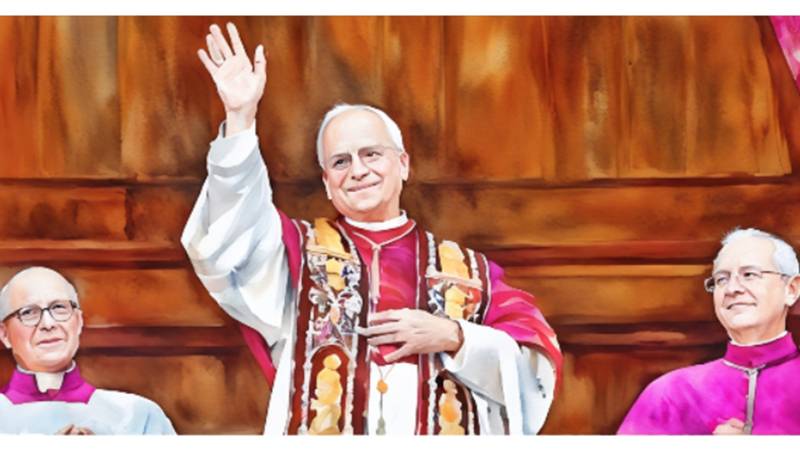
Indeed, “We have a Pope” (Latin: “Habemus Papam”). On the 8th of 2025, the new Pope was 70-year-old American Robert Francis Prevost, becoming Pope Leo XIV. However, I am not going to analyse the prospects of this pontificate – I think Andrea Lobo’s article does an excellent job of describing how it will be great for preserving the failing capitalist system in the world by giving it a “human face” – just as Pope Leo XIII did over a hundred years ago (yes, exactly: Prevost took the name Leo precisely because he knows that his mission is to save the world system).
I wanted to share a few thoughts on the influence of the late Pope Francis (Jorge Mario Bergoglio) on the world – especially the Western world. Of course, Francis’ past (as a cardinal, a bishop before that, and a Jesuit superior in Argentina before that) was at least chequered, if not altogether dark. Bergoglio was silent about the many atrocities of the extreme right-wing military junta in Argentina, as well as other neighbouring Latin American countries, through which Operation Condor – the CIA’s actions that killed almost 50,000 people, aimed at overthrowing leftist governments throughout Latin America and installing far-right juntas that then implemented neoliberalism, driving local populations into poverty and making those countries’ economies dependent on the US dollar – was sweeping through.
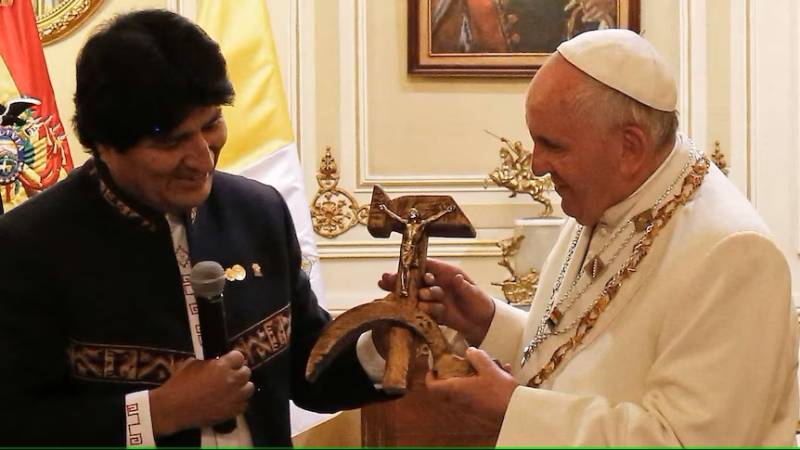
Bergoglio, despite being the superior of the Jesuit order in Argentina, also remained silent when the Bolivian junta brutally murdered Luis Espinal, a Bolivian Jesuit who took part in the Bolivian miners' strikes. Espinal is also the author of the cross which has the shape of a hammer and sickle, because he was one of those liberation theologians who combined Marxism with Catholicism. A replica of Espinal's cross in the shape of a hammer and sickle was presented by Evo Morales to Pope Francis in 2015.
Nevertheless, commentators—both Catholic and secular—have hailed Pope Francis as one of the more progressive popes in the history of the Catholic Church. In my opinion, this is not in of itself a sign of Bergoglio/Francis being progressive, but rather of how conservative the Catholic Church and the Western mainstream as a whole are.
Pope Francis during his twelve-year pontificate (his period as pope) has undoubtedly changed Western public opinion. As I say, this is not necessarily because he was so "progressive" himself, but because he came from Latin America and its problems – the horrific history of atrocities by the US, the consequences of which are poverty and crime that continue to this day – shaped him, and that is why he was unable to remain silent on these issues.
Pope Francis changed the discourse in Western public opinion, which until now believed that the world revolved around it and the whole world had to serve it
It was a huge shock to me that after the death of Pope Francis, when journalists and other commentators in the media – Polish, but also Western – began to evaluate the pontificate and predict who might be the successor, they raised topics that they never – and I write this very sincerely! – ever raised before. They took the view that the Catholic Church is currently the church of the Global South, because that is where it is developing most dynamically. Moreover, they expressed the view that the church in the Global South – Polish media have never even used this term before – has different perspectives and problems to deal with than the church in Europe.
Polish media criticised, also in comments after his death, Pope Francis for saying that NATO was to blame for the war in Ukraine. Pope Francis said that NATO “barking” at Russia’s door may have led to Vladimir Putin’s invasion of Ukraine. This view by the late pope is common sense in the countries of the Global South, and everyone in the world (except the West) knows that most of the problems the world is struggling with today are consequences of the actions of colonialism and/or NATO and the Western imperialist alliance. Yet, it caused huge outrage in Poland. Media, commentators, but even ordinary people and Catholics criticised the Pope and treated him paternalistically, saying “Well, the Pope is from Argentina, he doesn’t understand the problems of Europe, he doesn’t understand how evil Russia is – for them (residents of Latin America) the evil is America.”
I consider the fact that such words were said in the Polish public debate to be groundbreaking. Pope Francis, a day after the start of the special military operation in Ukraine, went on foot to the Russian Embassy in the Vatican to ask for an end to hostilities and a peaceful solution.
In 2022, Pope Francis asked two women – a Russian and a Ukrainian – to carry the cross during the Way of the Cross during the Good Friday ceremony in the Colosseum. For this, the Pope was also criticised for “equating the aggressor with the victim.” Instead of seeing this as a beautiful gesture of trying to reconcile two warring countries, the Western media began to attack the Pope for it. I do not expect that Pope Leo XIV, who called – of course three years ago during an interview – the Ukrainian-Russian war “a real aggression of an imperialist nature” [of Russia against Ukraine], will make efforts similar to those of his predecessor.
Pope Francis in 2024 during his pilgrimage to Singapore said something that no previous pope has dared to do. He said: "All religions are paths to God. There is only one God, and religions are like languages, paths to reach God. Some Sikh, some Muslim, some Hindu, some Christian." It must be said that this is a rather unusual statement from the mouth of the head of the Catholic Church. Looking at Pope Leo XIV, I do not think he would dare to say such words, considering that already in his first homily to the cardinals on the 8th of May 2025, he emphasised the doctrine of the Catholic Church repeated for almost 2,000 years, that "Jesus is the only truth."
This is one of the reasons why I am so grateful to Pope Francis. Not because of what he said, or what he did, etc, but because through his background he drove a wedge into the Catholic Church, which influences a large part of the world – even non-Catholics. Pope Francis changed the discourse in Western public opinion, which until now believed that the world revolved around it and the whole world had to serve it. We must consider Pope Francis' pontificate through his gestures: particularly the fact that he went on pilgrimage to countries where Catholics make up 2% of the population, and made priests from those countries cardinals ie those who elected his successor. All of this showed the West that it is no longer the centre of the world.
And in this context, unfortunately, I am a bit afraid of Leo XIV's pontificate. Because the Pope is a person who is widely listened to in the world. As I have already mentioned, the Pope is also listened to by people who are not Catholics – if only because the Pope, as one of the heads of state, is quoted by the media around the world. Therefore, the Pope has an influence on shaping public opinion.
Now, when the Pope is a man of American origin, and additionally a declared Republican voter (although supposedly an opponent of Trump – so, probably a Bush-style neoconservative), he is unfortunately not a good choice. Perhaps I am wrong. I hope that I am wrong and the new Pope will not continue his views from the past and weave them into the Catholic doctrine that affects the lives of 1.4 billion people around the world.
Much like the previous pope was a symbol of certain trends, it is tempting to see the new pope’s election as a symbol too. Leaks suggest that the cardinals were looking for a Pope who would preach a message of peace, given the risk of an approaching world war, and in the face of the collapse of the current world system. For his own part, the late Pope Francis had called the current situation in a very nice way "the third world war in pieces."
In my opinion, the College of Cardinals had more people who could carry forward this message, for example, Cardinal Joseph Coutts from Pakistan or Cardinal Charles Maung Bo. In both countries, Catholics make up only 2%. Both cardinals support peace and understanding in these two countries, which are strongly divided by ethnicity and religion. Of course, Cardinal Bo is criticised for maintaining contacts with the Tatmadaw or Burmese military regime, but after all, Christian doctrine is to bring peace, not to side only with the wronged. Jesus says in the Bible (Matthew 7:1-3) "Do not judge, or you too will be judged. For in the same way you judge others, you will be judged, and with the measure you use, it will be measured to you. Why do you look at the speck of sawdust in your brother's eye and pay no attention to the plank in your own eye?" – therefore, accusing Cardinal Bo of contacts with the youth in the face of his loud and active actions to protect the oppressed Rohingya community is a certain misunderstanding.
However, after a symbolic Pope from Argentina and the Global South, the College of Cardinals preferred and chose an American Pope from the largest imperialist country. In my opinion, this is a small disappointment.
Then again, on the other hand, one could hardly expect great steps forward from the ultra-conservative Catholic Church!