

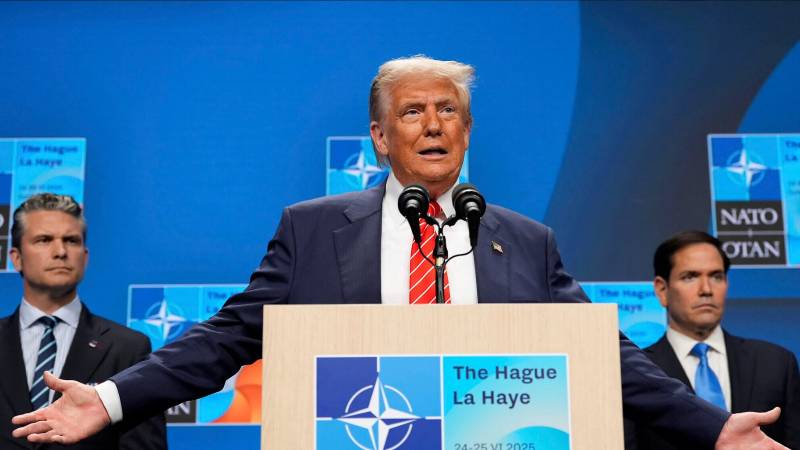
US President Donald Trump has again threatened to undermine the North Atlantic Treaty Organization (NATO), criticising allies for failing to support Washington during its ongoing tensions with Iran and reviving doubts about the future of the alliance.
Speaking after a meeting with NATO Secretary General Mark Rutte, Trump described the alliance as a “paper tiger” and suggested he was considering withdrawing the United States. On his Truth Social platform, he also criticised NATO’s stance during his earlier push to assert control over Greenland, a self-governing territory of Denmark.
“NATO wasn’t there when we needed them, and they won’t be there if we need them again,” Trump wrote.
Legal barriers to withdrawal remain
Despite the rhetoric, a unilateral US withdrawal from NATO remains unlikely. In 2023, Congress passed legislation—backed by then senator and now Secretary of State Marco Rubio—requiring congressional approval before any exit from the alliance.
However, experts caution that formal withdrawal is not the only way to weaken NATO. Measures such as reducing troop deployments or closing bases in allied countries could significantly erode its operational strength.
Trump previously ordered the withdrawal of 12,000 troops from Germany in 2020, a decision later reversed by Joe Biden.
Public support remains high but divided
Public opinion in the United States continues to favour NATO, though signs of political polarisation are growing.
Polling indicates that around 70 per cent of Americans view NATO membership as beneficial. Gallup surveys show record levels of support for maintaining or increasing US commitments to the alliance.
However, recent data from the Pew Research Center suggests a decline in support among Republicans, particularly following the escalation in tensions with Iran.
Even so, nearly six in ten Americans overall continue to hold favourable views of NATO.
Alliance role and limitations
NATO was founded as a collective defence organisation and is not obliged to support member states in conflicts initiated independently.
Its Article 5 mutual defence clause has been invoked only once—after the September 11, 2001 attacks—in support of the United States. Analysts note that comparisons between NATO’s response to Greenland and expectations during the Iran conflict are therefore limited.
Strategic pressure and wider implications
Officials suggest Trump’s criticism may be aimed at pressuring allies to provide logistical or strategic support, particularly in securing key waterways such as the Strait of Hormuz.
At the same time, critics argue that Trump’s broader foreign policy—including tariffs on allies and engagement with leaders such as Russian President Vladimir Putin—risks weakening alliance cohesion and the wider rules-based international order.
The long-term consequences of the Iran conflict, combined with renewed transatlantic tensions, are expected to shape NATO’s future and the United States’ role within it.